Shift from Reactive to Predictive Water Management in Hospitals
By Mohanraj Makkuni, Co-CEO & Director, Greenvironment
In a large hospital, water problems often reveal themselves only when they have already become visible to everyone else.
One multi-specialty hospital learned this the hard way when several visitors who had eaten at its food court began reporting illness. At first, the suspicion fell on food handling. But the investigation led elsewhere. The real issue was poor bacterial quality in the water being used inside the facility. Once identified, the hospital corrected it through tighter disinfection control and sensor-based monitoring. The incident was resolved, but it exposed a larger weakness common across healthcare infrastructure: hospitals usually discover water failures only after they begin affecting operations or people.
That delayed response remains the norm in many healthcare facilities. Water systems are still managed reactively. Action is taken after contamination appears, after treatment systems fail, or after complaints force attention. In hospitals, where water is tied directly to patient safety and clinical outcomes, that approach leaves too much to chance.

Mohanraj Makkuni, Co-CEO & Director, Greenvironment
Hospitals know less than they need to
Water in a hospital serves far more than basic plumbing needs. It supports drinking water access, sanitation, kitchens, cooling systems, laboratories, sterilization units, dialysis, and wastewater treatment. Each of these uses requires different quality standards, and failure in one area can quickly affect another.
In India, a multi-specialty hospital is generally planned around roughly 450 litres of water per bed each day. That water moves through storage tanks, underground reservoirs, pumps, treatment plants, and distribution lines before reaching its final points of use. The infrastructure is extensive, but visibility into it is often limited.
Most hospitals still rely on periodic testing and manual inspection. That creates blind spots.
Water conditions shift constantly. Stored water can lose disinfectant strength. Incoming supply quality may vary depending on whether it comes from municipal lines, tankers, or borewells. Cooling systems need water free from pathogens. Dialysis requires purity levels that cannot tolerate inconsistency. Wastewater systems must function continuously to prevent untreated discharge.
The problem is that many of these changes are invisible until they become serious.
Take three critical areas:
Drinking water must remain safe and stable for patients, visitors, and staff every day.
Wastewater must be treated properly before discharge or reuse, especially given the pharmaceutical residues present in hospital effluents.
Dialysis and clinical applications require close quality control because even small deviations create direct patient risk.
By the time these failures become visible in a reactive system, the damage has usually already begun.
What predictive monitoring changes
Predictive water management changes the timing of intervention.
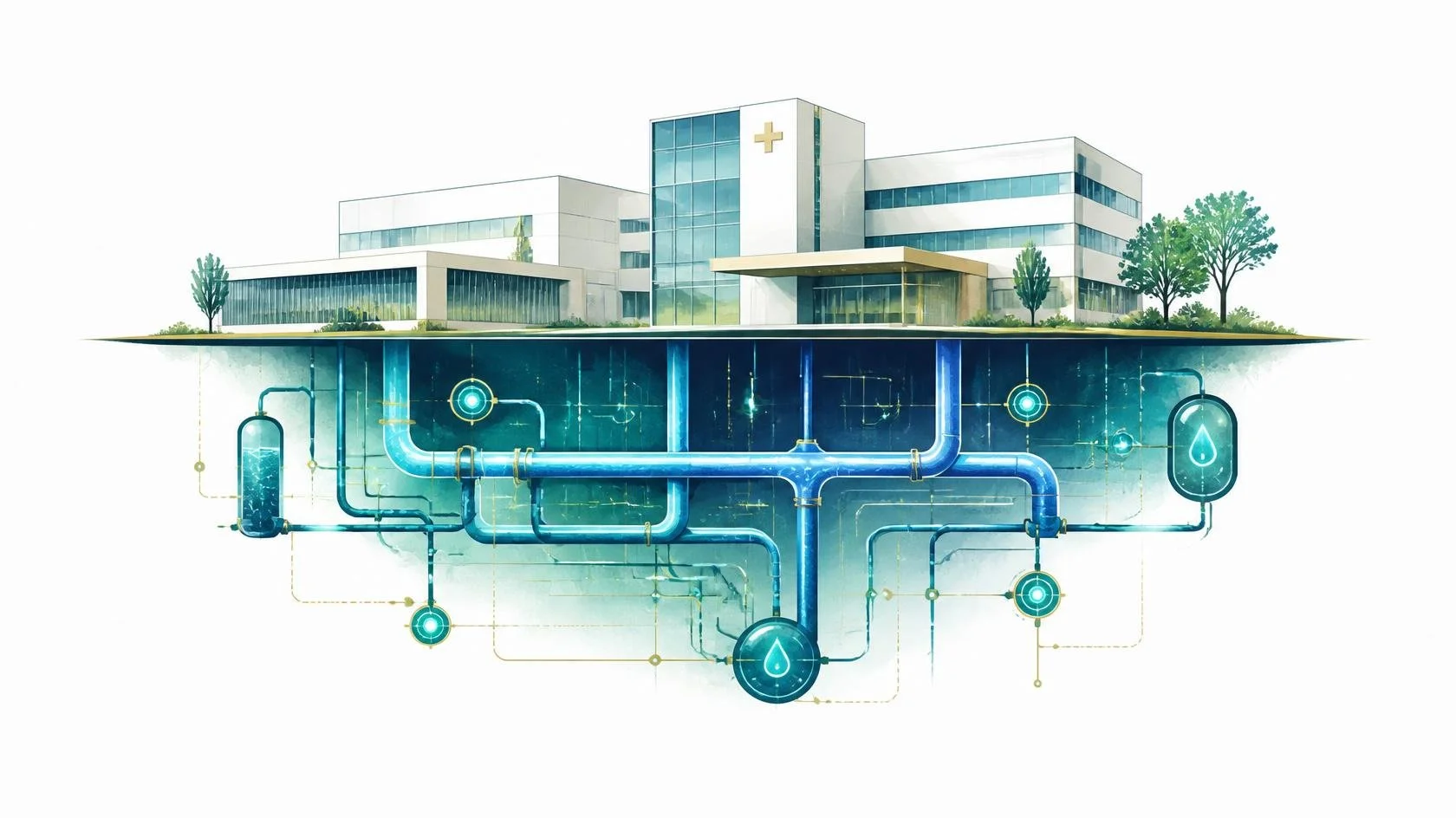
Instead of waiting for a visible breakdown, IoT-based systems monitor water quality, disinfection levels, flow rates, treatment performance, and equipment behaviour continuously. They detect irregular patterns early, often before a human team notices anything unusual. That matters most in failures that stay hidden.
In one hospital, a wastewater treatment plant stopped functioning properly without the engineering staff realizing it. The system was being managed by an outside vendor, and the breakdown went unnoticed until untreated wastewater had already built up. Because untreated hospital wastewater cannot legally enter public drains, the hospital had to arrange expensive tanker disposal while also purchasing replacement water.
The immediate loss was financial, but the compliance exposure was just as serious. With predictive monitoring, that kind of failure is detected much earlier. A drop in treatment efficiency triggers alerts before the issue escalates into a larger operational problem.
That is the real shift: not smarter reporting after failure, but earlier awareness before failure spreads.
The Shift to Predictive Monitoring
A 600-bedded pioneer in the health care sector in northern Kerala approached Greenvironment to reduce their escalating water demand, reducing water spend and the challenge of safe disposal of hospital wastewater.
As is the case with Healthcare facilities, it required water in huge quantities for diverse usage. Its daily water consumption was 750 kilo litres per day (KLD). The requirements ranged across drinking, hygiene, regulatory & care giving requirements such as hand-washing, food preparation, flushing toilets, laundry, cleaning, sterilization of surgical instruments, reprocessing of medical equipment and patient care, to safety (fire suppression) and landscaping and gardening.
The Challenge
As is apparent, the hospital generated wastewater in large quantities. Because hospital wastewater contains toxic, non-biodegradable, infectious pollutants and biologically active substances, which are harmful for human beings, aquatic life and environment, it is mandatory for hospitals to install a Sewage Treatment Plant (STP) for wastewater recycling. At our client’s facility, though the recycled outlet water from STP was widely used for toilet flushing and gardening, the actual usage of recycled water was limited due to concerns over the consistency in quality. On the other hand, the requirement of water for non-potable purposes was also on the rise. Lack of efficacy of the wastewater recycling plants and process was also observed.
The Solution
The client introduced Greenvironment’s real time monitoring system (RTM) to increase the efficacy of the existing STP and improve the quality of the recycled water to ensure its reuse in its hospital. The RTM also needed to alert STP operators to take corrective action in case of discrepancy in treated water quality as part of their operating standards. Along with RTM, an automatic Chlorine dosing system was also installed, which helped in maintaining the treated water quality at the levels fit for reuse. With the improvement in the quality of treated / recycled water through corrective measures enabled by RTM, the hospital gained the confidence to reuse their STP treated water for multiple purposes such as toilet flushing and gardening.
The outcome
Though the estimated water requirement for a 600 bed hospital, as per the norms of the Bureau of Indian standards was 450 KLDs, BMH’s actual fresh water consumption was at almost double. (750 KLD). With the introduction of Greenvironment’s RTM, recycled water met many of the non-potable needs and total water consumption of the hospital was reduced by 99 KLDs Cumulatively, over a span of four years there was 33% reduction in the consumption of freshwater.
Why hospitals in India are paying attention now
This conversation is gaining urgency because the context around water in India has changed.
Hospitals were once among the first institutions guaranteed municipal water supply. That is becoming harder to sustain in water-stressed cities. Demand is rising faster than supply, and large hospitals now require enormous volumes every day, sometimes close to one million litres.
When municipal supply falls short, hospitals turn to tanker water, borewells, and mixed sources. These alternatives are expensive, inconsistent, and often unpredictable in quality.
At the same time, regulation has become stricter.
Hospital wastewater is under closer scrutiny because of antibiotic residues, chemical traces, and contamination risks. Disposal failures now bring not just operational disruption, but regulatory consequences as well.
There is also a broader shift inside the sector. More hospitals are now part of global healthcare networks, where infrastructure standards are higher and sustainability targets are no longer optional. Water efficiency is moving beyond engineering departments and entering strategic planning discussions. That is changing how hospitals think.
Water is no longer treated as an invisible utility that can be managed only when something breaks. It has become a resource tied directly to cost, compliance, resilience, and patient safety. Predictive water management is gaining relevance for one simple reason: hospitals can no longer afford to wait for failure before they act.
In healthcare, the most important systems are often the least visible. Water is one of them. And in the years ahead, the hospitals that manage it best will be the ones that stop reacting late and start seeing problems early.
Got a story that Healthcare Executive should dig into? Shoot it over to arunima.rajan@hosmac.com—no PR fluff, just solid leads.