
Can a Star Rating Fix What Ails Maharashtra's Public Hospitals?
By Arunima Rajan

The state's new system will grade hospitals from zero to five stars, but experts say ratings alone can't solve a shortage of doctors and specialists
According to a recent government order, the Maharashtra government has decided to launch a “Star Rating System” to assess and publicly rate the quality of hospitals under its Public Health Department. But will a rating system alone fix the problems of the healthcare system when the state already has a shortage of specialists? Does it make sense to rate a government facility in a rural area based on the number of specialists it has? And if hospitals are rewarded for higher OPD numbers or more admissions, healthcare executives will find ways to game that too.
One of the biggest challenges patients face in India is the lack of data on a hospital's clinical efficiency. Even hotels have rating systems, but public health infrastructure has offered little comparable information. Maharashtra's new star rating system is an attempt to change that for its government facilities.
What the Star Rating System Measures
The system rates hospitals against five broad standards:
Availability of services and responsiveness. Every hospital needs adequate staff who are consistently present and responsive. Patients should be able to access the services their illness requires, with the right doctors and support staff on hand.
Diagnostic tests and medicines. Patients recover faster when relevant tests are done on time and the medicines they need are available in-house. The system measures how much hospitals actually use and stock their labs, essential medicines, X-ray and ECG services.
Hospital efficiency. Outpatient registrations and bed occupancy in inpatient wards are tracked because sustained use signals public trust in the hospital.
Medical services. The number of safe deliveries and surgical procedures performed indicates the level of care a hospital can deliver.
Patient amenities and experience. This covers hospital cleanliness, how patients and families are treated, and general humanitarian support. Patients are asked directly about their experience, and facilities are physically inspected.
Mayank Banerjee, co-founder of the integrated healthcare provider Even, welcomes the move. “Checks and balances should be system-agnostic, as they ensure certain baseline standards are maintained irrespective of the system. That said, a rating system also helps build patient trust, and this initiative by the Maharashtra government is a welcome move. As for the absence of choice in rural areas, I believe any initiative aimed at improving healthcare delivery should be encouraged to trickle down to the last mile. I hope the benefits of the new initiative will eventually reach every district in the state,” he says.
Even, which has recently opened hospitals in Bengaluru, says clinical outcomes, quality of care and adherence to evidence-based protocols sit at the centre of how it delivers care. The company has built a proprietary clinical assessment tool, CAT, that it uses across its hospitals. Banerjee says Even's approach is rooted in preventive and managed care, so its responsibility doesn't end once the immediate condition is treated; the company aims to stay involved in a patient's health over the long term. “That means taking even the smallest red flag seriously and acting on it early. CAT strengthens our clinical governance by helping us monitor quality, protocol adherence and patient outcomes across the entire care journey, from diagnosis and treatment to discharge and follow-up.”
How Other States Are Approaching This
Andhra Pradesh has moved away from ranking its primary health centres purely on volume, i.e. how many outpatients, diagnostic tests or deliveries a centre logs, and shifted instead to an outcome-based rating system, with the stated aim of making healthcare more accountable and results-driven.
Rajasthan runs a public Kayakalp portal where anyone can look up the ranking of its health facilities, whether that's a PHC, an Anganwadi centre, a CHC or a sub-centre.
Kerala has a comparable ranking effort, though its trigger was different: curbing antimicrobial resistance, the phenomenon where germs stop responding to medicines because of excessive or unscientific antibiotic use. As part of this push, the state's Health and Family Welfare Department issued a standard operating procedure aimed at making hospitals “antibiotic-smart.” It also introduced a colour-coded scale to make hospital performance easy for the public to read at a glance: light blue marks the highest standard, with dark blue, green, yellow and pink assigned to lower grades. Government documents indicate all government hospitals are expected to be brought under the system within three months.
A Similar Idea, a Decade Earlier
This isn't the first time a hospital star-rating scheme has been proposed in India. In 2016, the Union Ministry of Health drew up plans to rate public health institutions nationwide on a zero-to-five-star scale based on service availability, starting with community health centres, the third tier of the National Health Mission. The first phase also floated a five per cent incentive within National Health Mission funding to states, tied to the cumulative star ratings of their public health centres.
To guard against hospitals inflating their own numbers, the guidelines set a minimum bar before any star could be awarded. A facility needed at least two doctors (including a specialist), six nurses or auxiliary nurse-midwives, and one lab technician, along with separate toilets for men and women, an operating theatre and a generator. Clearing this bar earned a facility its first star automatically; stars two through five depended on factors such as drug availability, client orientation and how much the facility was actually used. The fifth and final star required specific usage thresholds each month: at least three IUD insertions, ten measles patients treated, an inpatient midnight census of 450 or more over the month, and OPD attendance of at least 750. Maharashtra's current initiative, in other words, revives an idea the central government first attempted a decade ago.
How Hospitals Are Assessed and Rated
Each hospital is assessed against ten indicators drawn from the standards above, and these are set separately for each category of institution – rural hospital, sub-district hospital, district hospital, super-specialty hospital – so that a facility is judged only on what falls within its actual scope of work. The government can revise these indicators over time.
Each of the ten indicators is scored as either “complete” or “incomplete.” A completed indicator earns half a star; an incomplete one earns nothing. Adding up all ten gives a hospital's final score: a hospital that clears all ten indicators gets five stars, and one that clears none gets zero. Every indicator is checked through both a physical inspection and a review of database records, with a detailed inspection schedule to be issued separately by the department.
One gap worth flagging: the assessment tracks how many procedures a hospital performs, but not how safely or successfully those procedures go. That's a metric policymakers may want to add.
Which Hospitals Are Covered
The system applies to all rural hospitals, sub-district hospitals, general hospitals, women's hospitals, district hospitals, referral service hospitals, and hospitals under the State Employees' Insurance Scheme that fall under the Public Health Department.
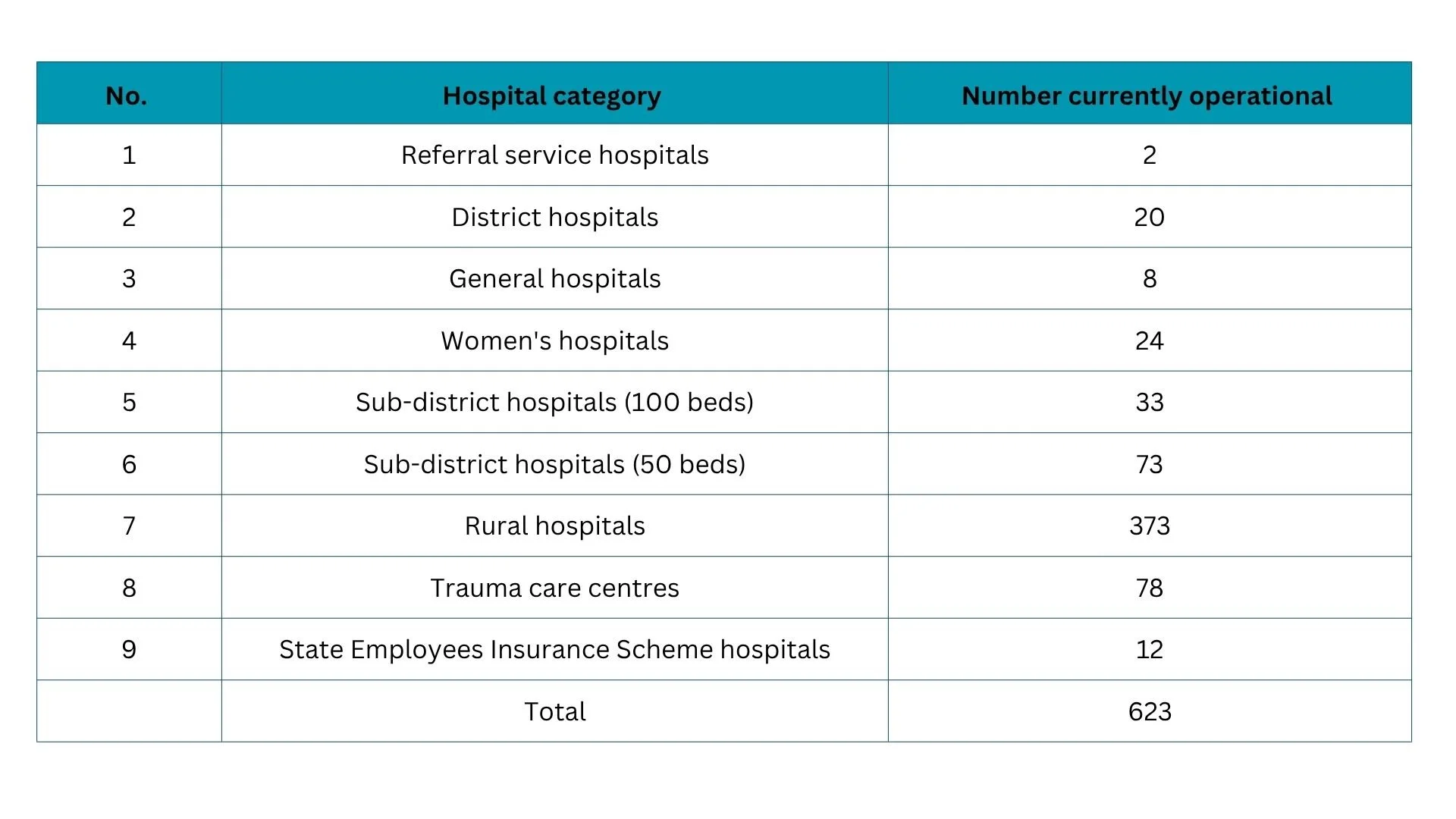
How Often Ratings Are Published
Ratings are declared twice a year, in January and August, based on a physical assessment and a review of each hospital's database covering the period since the previous assessment. Hospitals that score four stars or higher receive a certificate of merit.
The Ten Criteria at a Glance
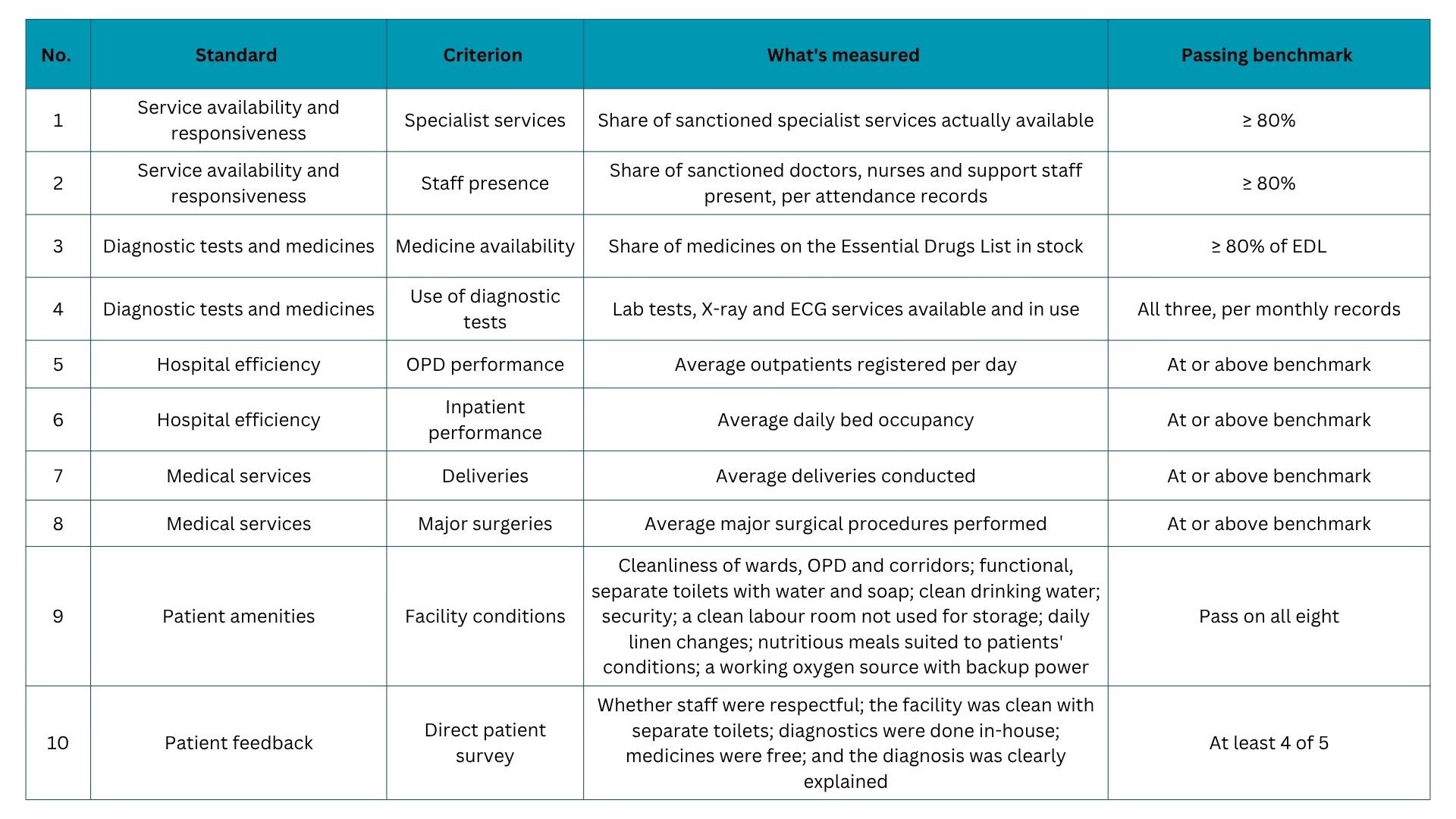
Benchmarks for criteria 5 to 8 are set separately for each level of hospital. Patient feedback is gathered independently, through random phone calls to patients who used the hospital's services.
What Would Make a Rating Meaningful
Banerjee argues that any serious attempt to fix India's systemic healthcare problems is a step in the right direction, and that this one gets the basics right: specialist availability, essential medicines, functioning diagnostics, cleanliness and patient experience. But he believes the real test of a hospital's safety is whether its doctors are consistently making the right clinical calls based on evidence, not just whether the ingredients for good care are present.
If he were designing the rating himself, he says he'd focus on four things: clinical quality (are protocols followed consistently?), safety (infection rates, medication errors, avoidable complications and readmissions), readiness (staff, medicines, diagnostics, equipment and emergency services), and outcomes and experience (does the patient recover well, with clear communication and continuity of care after discharge). “The shift should be from measuring whether a hospital has the ingredients for care to whether it consistently delivers the right care and outcomes,” he says.
The Risk of Rating Without Fixing
A rating system does help patients understand a facility's strengths. But it has a real weakness: a hospital can look good simply because it's busy, since high patient volume itself pushes the score up. It's also unclear what actually happens to a government facility once it receives a poor rating.
The real opportunity here is to use low ratings as a trigger, directing funds and setting deadlines to fix underperforming hospitals, then reassessing them. The risk is that a poor rating damages public trust in a facility while the underlying problems go unaddressed. There's also a perverse incentive built into rewarding occupancy: a hospital chasing a better score on bed occupancy or OPD numbers could end up pushing unnecessary hospitalisations and repeat OPD visits, which would ultimately hurt the very patients the system is meant to protect.
Got a story that Healthcare Executive should dig into? Shoot it over to arunima.rajan@hosmac.com—no PR fluff, just solid leads.