
Maharashtra Scraps Medical Bond: Relief for Graduates, Uncertainty for Rural Healthcare
By Arunima Rajan

As the state abolishes two decades of mandatory service for MBBS graduates, resident doctors celebrate reduced delays while public health experts warn of deepening rural staffing shortages.
When Maharashtra abolished its mandatory one-year rural medical bond on July 23, 2026, it ended a 20-year-old policy framework built on a simple premise: subsidized education requires public service. Governed by Resolution MED-1026/P.K.239/26/Education-2, the sudden phaseout was framed by state officials as a practical response to administrative bottlenecks. Yet, beneath the official narrative lies a fierce debate. While resident doctors celebrate the end of career-delaying red tape, public health researchers warn that dismantling the bond system without a robust recruitment alternative could leave rural infrastructure entirely stranded.
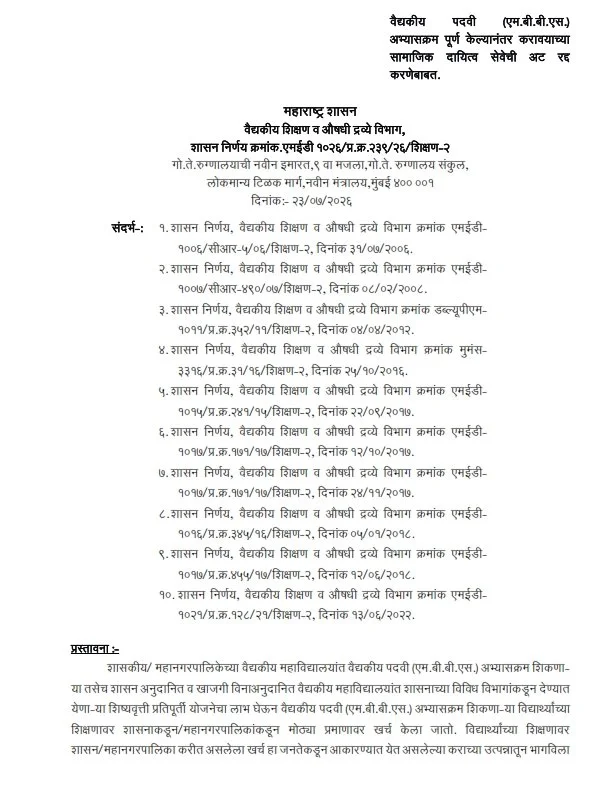
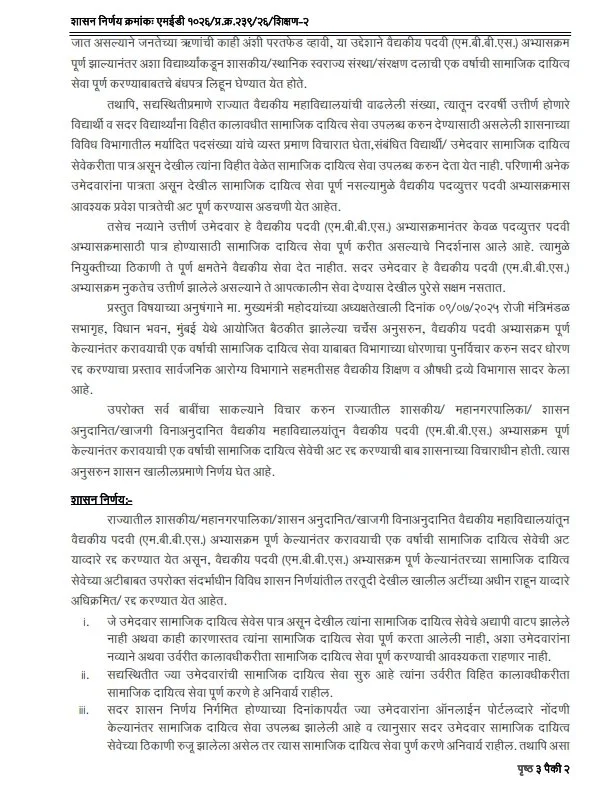
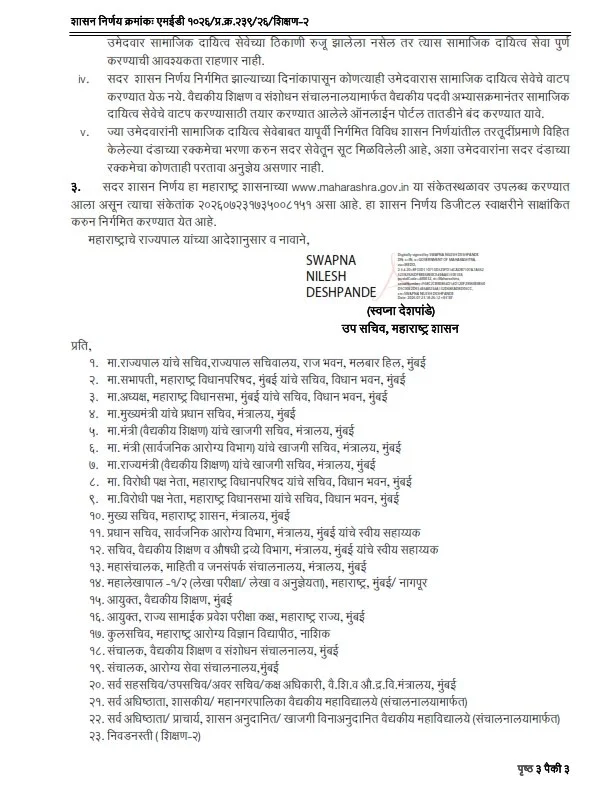
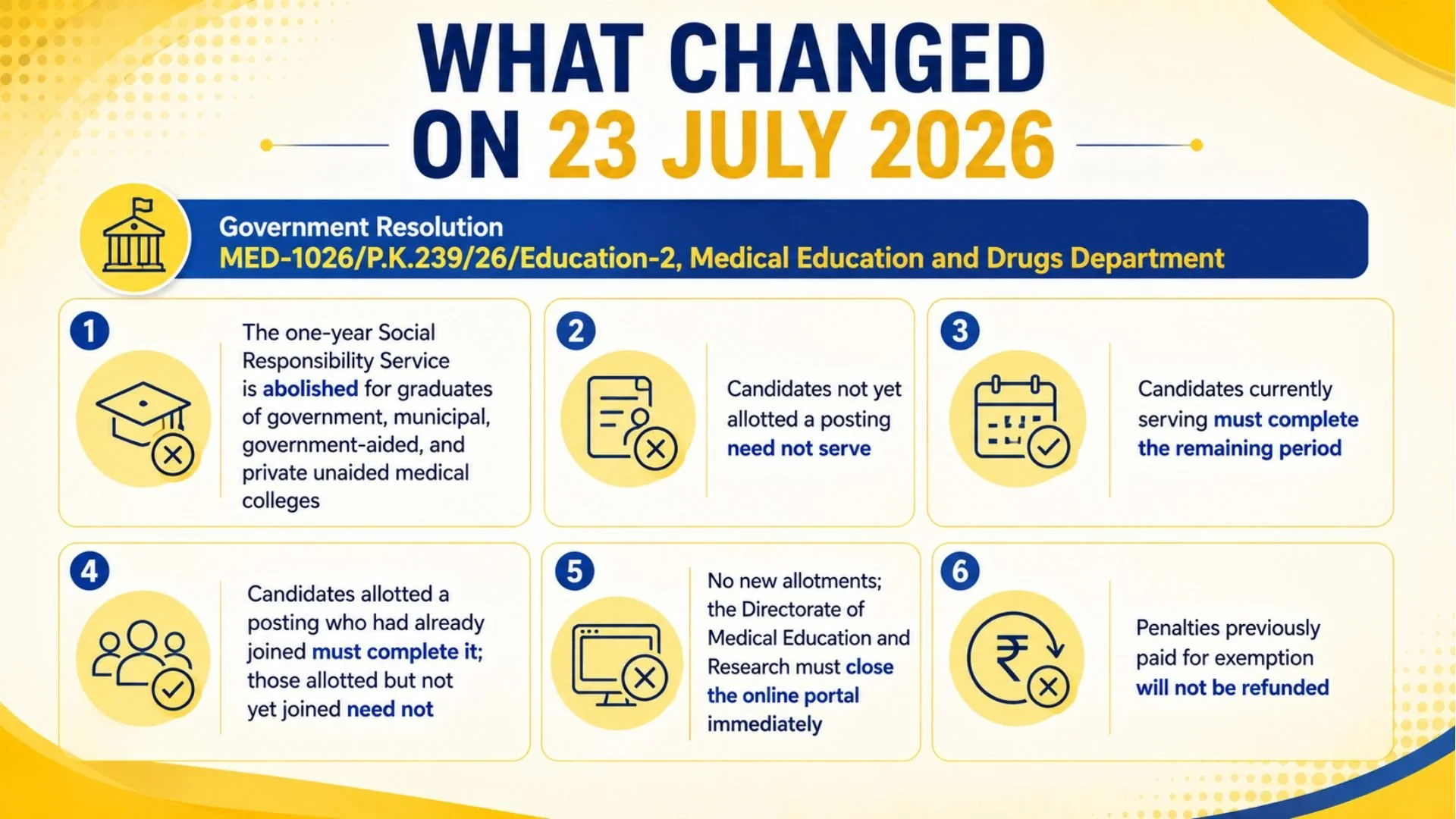
The Government Resolution MED-1026/P.K.239/26/Education-2, issued on 23 July 2026, abolishes the compulsory one-year Social Responsibility Service for MBBS graduates of government, municipal, government-aided, and private unaided medical colleges. Researchers and resident doctors’ representatives are divided on what the decision means for rural facilities. Responses from the Association for Socially Applicable Research were provided by email. The specialist research cited was conducted in Rajasthan. Both resident doctors quoted hold office in the association representing the doctors this policy governs.
Since at least 2006, MBBS graduates whose education Maharashtra had subsidised owed the state one year of Social Responsibility Service. On 23 July 2026, the state abolished the requirement. Candidates not yet allotted a posting need not serve, no new allotments will be made, and the online portal has been closed.
The resolution cites a mismatch between the number of graduates and the sanctioned posts available to absorb them, delays that blocked postgraduate admission, and graduates completing the service only to qualify for postgraduate study. Media reports of the Chief Minister-led meeting of 9 July 2025 that preceded the decision described an additional rationale: that the near-tripling of MBBS seats since 2006 had produced sufficient doctors for rural centres. That claim does not appear in the resolution’s text, and it is the one the researchers below dispute.
Whether rural health facilities will feel the loss is contested. Healthcare Executive asked researchers who study the health workforce and office-bearers of the resident doctors’ association what the decision changes.
Siddhesh Zadey: the shortage is real, but the bond barely touched it
Siddhesh Zadey, co-founder of the Association for Socially Applicable Research (ASAR) India, says rural staffing in Maharashtra falls well short of international benchmarks.
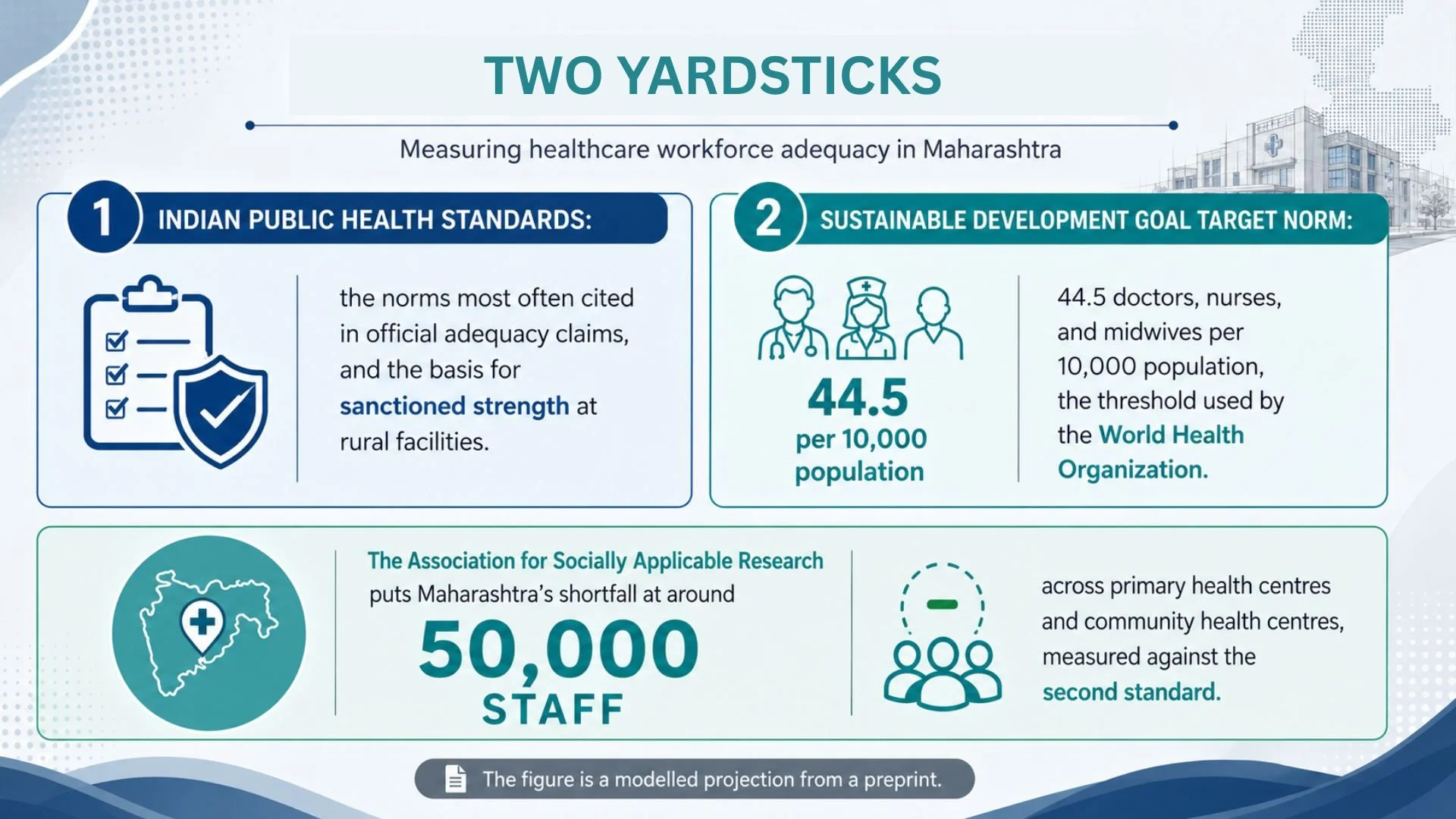
“Considering the Sustainable Development Goal targets, PHCs and CHCs in Maharashtra have a shortage of around 50,000 doctors, nurses, and auxiliary nurse midwives,” he says. The figure comes from the organisation’s 2030 projections, published in a peer review journal recently. This is a modelled estimate rather than a headcount, as recent state-level workforce data are unavailable. “This paper does not separately analyse doctors. It combines doctors, nurses, and midwives because that’s how the WHO sets the target.” The group’s earlier peer-reviewed work analysed the cadres separately: “We found a shortage of doctors at PHCs and CHCs in Maharashtra and India.”
He points to the state’s auditor in support. “These findings match with the most recent CAG Performance Audit on ‘Public Health Infrastructure and Management of Health Services in Maharashtra’. Appendix 2.1 (A) shows that compared to the sanctioning strength, not a single district in Maharashtra has an excess of doctors at district hospitals, rural hospitals, sub-district hospitals, CHCs, and PHCs. Some have adequate staffing, but most have large shortfalls.” The audit, tabled in the legislature in December 2024, reported a 22% shortage of doctors and a 42% shortage of specialists under the Public Health Department.
He also questions the norms used in official adequacy claims. “Governments often cite old IPHS norms to make claims about adequacy. However, these are outdated norms. They do not follow international standards set by the WHO and other organisations. And as we have shown, they severely underestimate the required number of doctors at rural healthcare centres. So, calling staffing adequate based on IPHS required norms, especially for CHCs and PHCs, is not useful.”
On the bond itself, his expectation is limited aggregate effect. “I cannot put a number on it because bonding data are not very well documented. However, bonding hardly produces any functional posts. So, removing it won’t change the projections much.”
The exception, he says, is local. “It might cause important differences in specific districts. If a district had only 1 bonded MO (medical officer) and now has none, that’s a big difference, because that determines whether the PHC will be open or not. So, the overall numbers may not change much, but in some critical places, bonding does make a difference.”
On distribution, he cites national figures from earlier published papers. “The rural-urban ratio of doctors at the India level is about 3:7, which is exactly opposite to the population ratio. So, unfortunately, the majority of Indians are being served by a minority of doctors.” On Maharashtra: “My best estimation is that this won’t be any different for Maharashtra.”
Dr Jeewan Meher: scrapping it was the wrong answer
Dr Jeewan Meher, state convener of the Central Maharashtra Association of Resident Doctors and president of the association at Government Medical College, Miraj, wanted the bond retained.
“The Social Responsibility Service was repayment, not punishment. The state pays for your degree and you give back a year, and it could be done at any government institution, not only a rural posting. It applied to UG and PG alike, and you couldn’t simply walk away. There was a bond amount, and colleges held your original certificates until you completed it.”
The resolution’s preamble is consistent with his description of the posting options: it describes service at a government institution, a local self-government body, or the defence forces, with no rural requirement in the operative text.
He rejects the characterisation of government postings as a hardship. “Government service isn’t the hardship posting it once was; our PHCs and district hospitals have improved.”
What broke the scheme, in his account, was scale. “But the supply picture changed completely. In Maharashtra, roughly 4,150 graduates a year from government colleges were competing for something like 50 to 100 bond postings a month, and last October close to 900 were still waiting for an allotment.” The figures are from association records rather than published data.
His conclusion: “Scrapping it was the wrong answer to that problem.”
The Rajasthan study: compulsion was never going to work
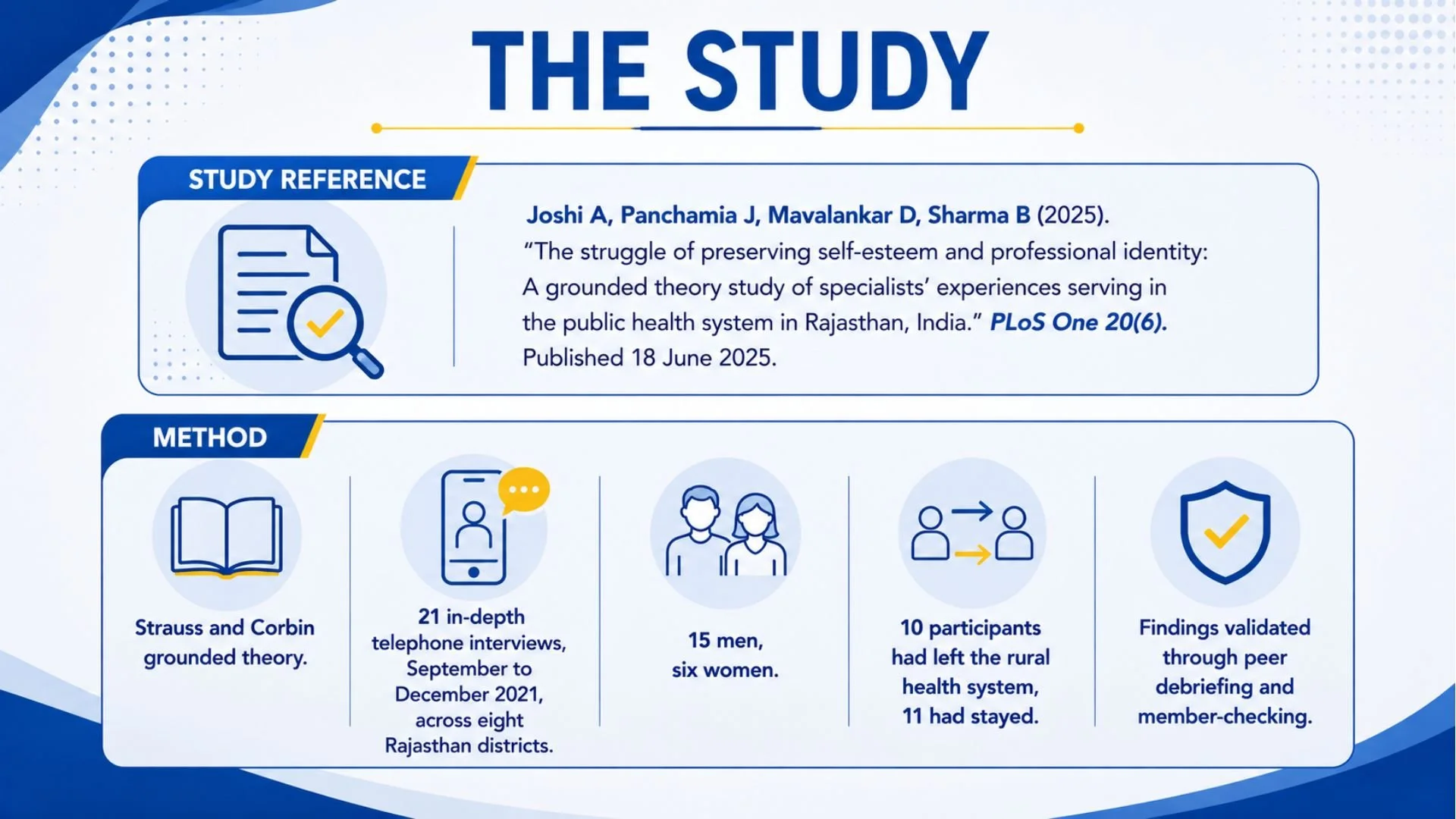
A study published in PLOS One on 18 June 2025, “The struggle of preserving self-esteem and professional identity”, examined specialists’ experiences of serving in Rajasthan’s public health system. Its authors are Anushree Joshi, Dr Jallavi Panchamia, Dileep Mavalankar, and Dr Bharati Sharma. Panchamia is associate professor and Sharma former associate professor at the Indian Institute of Public Health Gandhinagar (IIPHG); the two responded jointly to Healthcare Executive’s questions. The authors report no specific funding for the work and no competing interests.
The study drew on 21 in-depth interviews conducted by telephone between September and December 2021, a constraint of the COVID-19 pandemic, with specialist physicians, postgraduate residents, and retired specialists across eight Rajasthan districts: Sikar, Jhalawar, Jodhpur, Bikaner, Jaipur, Bhilwara, Jhunjhunu, and Nagaur. Fifteen participants were men and six women; 10 had left the rural health system and 11 had stayed. The authors used Strauss and Corbin’s grounded theory approach. The findings concern specialists in another state rather than Maharashtra’s fresh graduates, and the fieldwork predates the Maharashtra decision by nearly five years.
The national backdrop is documented in government data: Rural Health Statistics 2022-23 records 913 surgeons in position at rural community health centres against 5,491 required, part of a nearly 80% shortfall across the four specialist cadres. “Policy responses so far have mostly relied on bonds and financial incentives without asking what actually happens to a specialist once they arrive at a rural posting,” the researchers say.
Their position on compulsion: “Compulsion may temporarily improve deployment. It cannot ensure a committed or sustainable rural health workforce without supportive work conditions.”
Participants described inadequate infrastructure, shortages of equipment and staff, administrative burdens, limited professional autonomy, and political interference. “These conditions affected not only service delivery but also their sense of professional identity and self-esteem,” they say. “There was a mismatch between what specialists are trained to do and what the system allows. This mismatch led to deskilling, discomfort, and eventual exit even among those who initially complied. A similar observation has been reported by the Maharashtra health officials in the recent policy decision related to the withdrawal of the MBBS graduate bond.”
Retention, they found, was not primarily financial. “Retention was driven by much more than salary or incentives. Specialists consistently spoke about the importance of meaningful clinical work, professional fulfilment, and being able to deliver the quality of care they were trained to provide.” And the burden was uneven: “Female specialists face this struggle even more acutely, contending with gender stereotyping and safety concerns on top of everything else.”
On the bonds Maharashtra has kept for postgraduate and super-speciality doctors: “Our participants who stayed did so mainly for reasons unrelated to bond compulsion. If PG and super-speciality bonds are retained without addressing the systemic issues described earlier, we may expect the same pattern of reluctant compliance and exit at the first opportunity.”
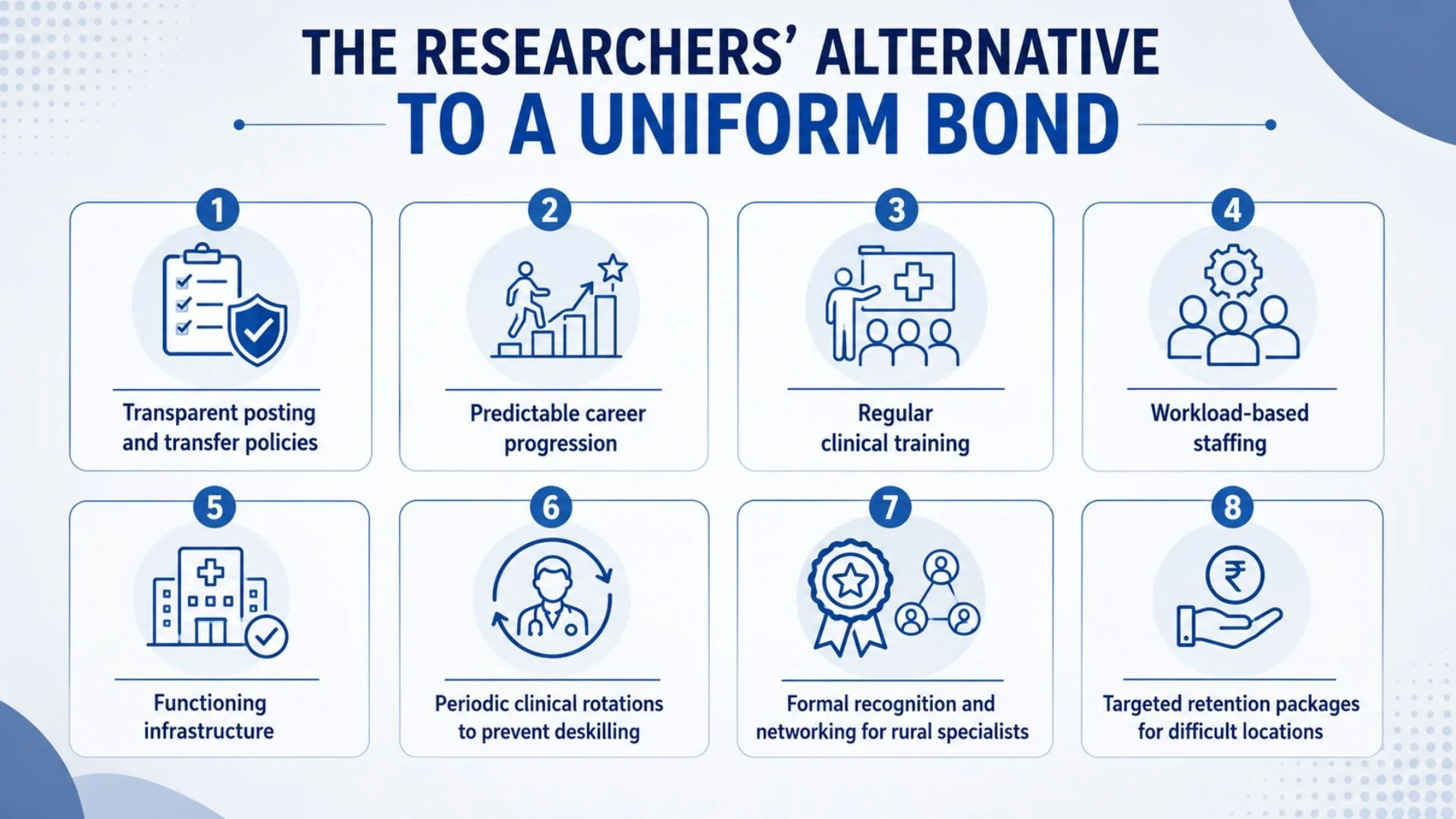
Their alternative: “Moving away from compulsory service should not mean moving away from rural workforce planning.” They propose transparent posting and transfer policies, predictable career progression, regular clinical training, workload-based staffing, and functioning infrastructure, which they describe as “organisational reforms rather than high-cost interventions”, along with targeted retention packages for difficult locations, periodic clinical rotations to prevent deskilling, and formal recognition for rural specialists.
“The evidence suggests that creating an enabling professional environment is more likely to improve both retention and quality of care than relying solely on compulsory service.”
Dr Suyash Hanamant Dhavane: welcome the decision, worry about jobs
Dr Suyash Hanamant Dhavane, general secretary of the Central Maharashtra Association of Resident Doctors for 2025-26 and co-convenor of the Indian Medical Association Junior Doctors Network in Maharashtra, supports the decision. Opinion among graduates, he says, split according to what they wanted next: those pursuing postgraduate study wanted the bond cancelled, while those seeking work wanted it kept.
“This decision will undoubtedly benefit students aspiring for postgraduate education, and it deserves to be welcomed.”
His concern is employment. “With the removal of the compulsory bond, MBBS graduates may no longer have access to the assured one-year government employment that was previously available to them,” he says, along with the fixed monthly remuneration that came with it. In his assessment, the bond’s existence had also encouraged private hospitals to offer competitive salaries to graduates.
“While supporting this decision in the interest of PG aspirants, it is equally important to ensure that the professional value and dignity of an MBBS degree are not diminished.” The government, he argues, should create employment for graduates as medical officers in the public health system or in government medical colleges. “Alongside academic advancement, ensuring employment security for MBBS graduates should remain a key priority.”
What to track
Zadey proposes three indicators for whether the decision affects rural care.
Staffing against the Sustainable Development Goal norm: “44.5 doctors, nurses, and midwives per 10,000 people. Rural India, including Maharashtra, is still far away from achieving that. However, achieving this is possible through proper deployment and retention schemes/incentives.”
Outpatient utilisation: “Having doctors at centres is not useful if people don’t utilise services and if we cannot show the footfall. Outpatient department (OPD) footfall reacts to small staffing changes. So, it is a good dynamic indicator of whether removing bonding is dissuading healthcare utilisation or not.”
Surgical volume: “From a health system perspective, if a hospital can perform surgery, it can handle almost anything else because that indicates it has the necessary infrastructure, staff, equipment, consumables, and other resources to provide a wide range of services that are less complex than surgery. Several simple surgeries can be done very easily with just one doctor present.”
Got a story that Healthcare Executive should dig into? Shoot it over to arunima.rajan@hosmac.com—no PR fluff, just solid leads.