
Beyond Star Doctors: What Team-Based Care Looks Like Inside a Women-and-Child Hospital
By Arunima Rajan
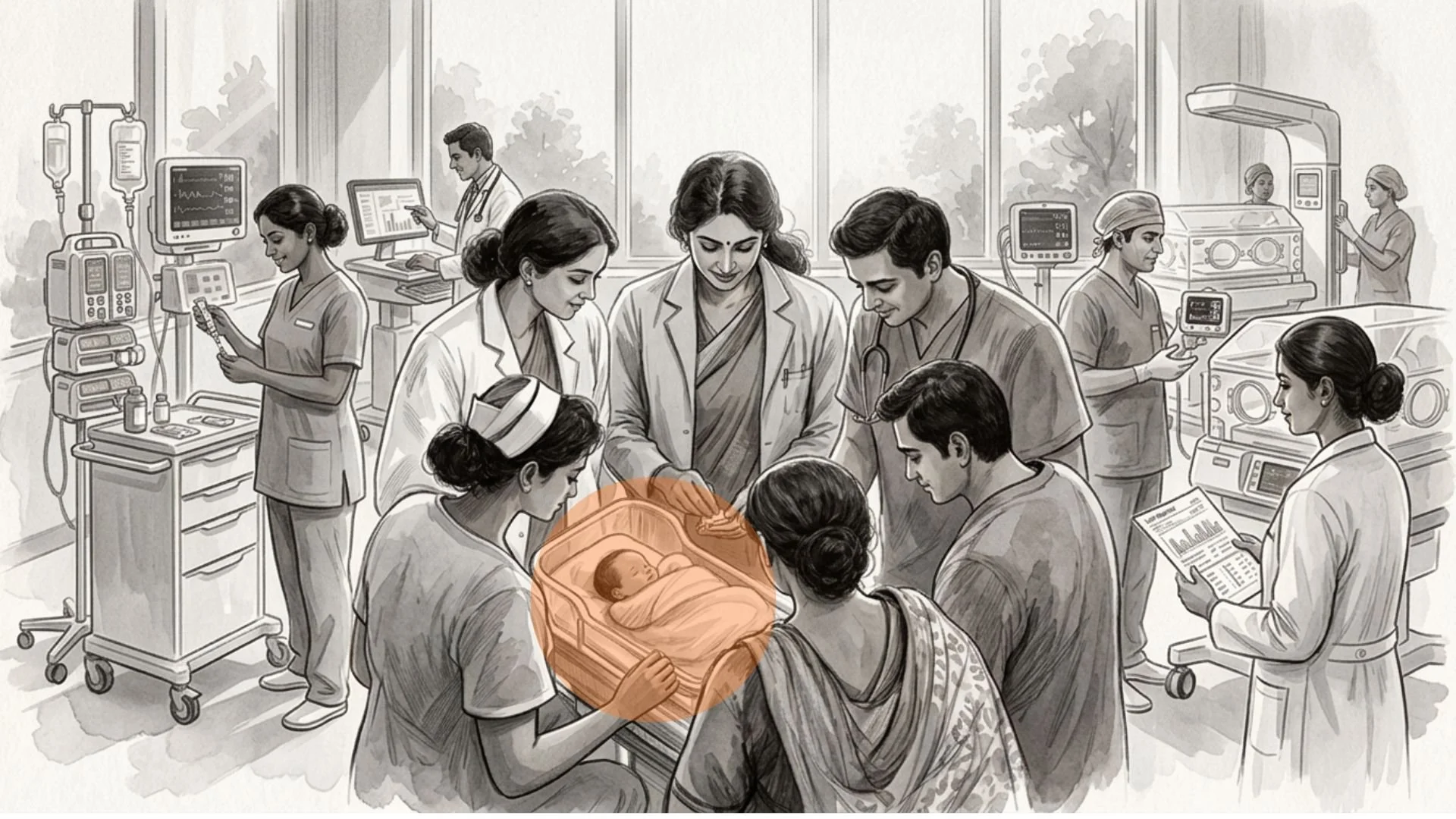
In an interview with Arunima Rajan, Krishna Prasad Rao Vunnam, Founder, Ankura Hospitals for Women & Children, says that healthcare has traditionally been built around individual names, but it is a team effort. Exceptional care cannot be delivered in isolation. Behind every successful outcome is an entire ecosystem of skilled clinicians, nurses, technicians, and support staff working together.
Was medicine a calling, a family expectation, or simply the natural path for a bright student of that era?
I grew up in Guntur, a small town in Andhra Pradesh, in a business family. Watching my family work taught me the value of commitment, hard work and building something that lasts. But choosing medicine was completely my own decision. I always wanted to become a doctor because I felt it was one profession where you could make a real difference in people's lives.
After completing my medical education, I moved to Australia, where I did my Fellowship in Neonatology. Those years gave me a different perspective on healthcare. I saw how specialised care, good systems and teamwork could make a real difference to both patients and doctors.
When I came back to Hyderabad and started practising, I felt that children's healthcare needed more focused attention. There were good hospitals, but very few that were built entirely around the needs of children. As a neonatologist, I saw that every day. That made me think beyond my own practice. Along with a group of like-minded consultant doctors, we decided to build a hospital dedicated to children.
As Ankura grew, something interesting happened. Parents who trusted us with their children began asking if we could offer the same kind of care for mothers as well. We realised that families were looking for specialised care throughout their journey ,from pregnancy to childbirth and then for their children. Expanding into women's healthcare was therefore a natural step. It was not about adding another specialty, it was about completing the care that families were looking for.
Looking back, I don't think there was one defining moment that changed everything. It was a gradual journey of listening to patients, understanding what they needed and building an institution around those needs.
Thinking back to your years in neonatal care in Sydney, what did you observe there that you knew was missing in India?
The patient volume in India is significantly higher than in most developed nations, making the challenges here very different.
What stood out to me in Sydney was not just the technology but the consistency of systems, well-defined protocols, multidisciplinary teamwork, meticulous documentation, and a culture where every premature baby was given the best possible chance, regardless of how complex the journey might be.
In India, with a much higher patient load, the real need is for systems that ensure consistency and quality of care, regardless of the demand. Many of the protocols that we follow are based on internationally accepted standards. The challenge is not in defining these protocols but in adhering to them with the same rigour every single time, especially in high-volume settings. Here we need to adapt that level of discipline to our own realities by building stronger processes, investing in continuous training, leveraging technology where appropriate, and creating systems that make adherence easier even under demanding workloads.
Ultimately, excellence in neonatal care is not achieved by having better guidelines alone, but by ensuring that evidence-based care is delivered consistently to every baby, every time.
Looking back, was the founding insight primarily a moral one or a market one? And do you find the two can be separated at all?
Ankura was born to make the unseen seen. It started as a neighbourhood hospital with the intend to make specialised healthcare accessible to more women and children. I never looked at the market; I looked at the need. I did not begin with a ten-year expansion plan in my hand. My focus was much simpler: to help more women and children access quality healthcare, save more newborns, reduce maternal and neonatal mortality, and raise the standard of care available to them. Every decision was guided by that purpose.
Today, even when Ankura has grown into a pan-India network, that focus remains unchanged. The moral purpose came first and continues to guide us. The market follows because when you solve a genuine problem consistently, people place their trust in you. Growth, in that sense, becomes an outcome rather than the objective.
I believe morality and the market are two separate entities. From the outside, as a hospital expands and broadens its services, the line between them may appear blurred. But internally, the distinction is very clear. The vision has always been to improve healthcare for women and children. Expansion has simply enabled us to fulfil that vision for many more families.
Could you walk me through a concrete example, perhaps a single patient's journey, of something that unfolds differently at Ankura?
Healthcare is not technical, nor does it work like a linear mathematical equation. Every woman and child is unique, and so are their healthcare needs. In a dedicated destination for women and children, they are not just treated; they are understood. Their individual health needs and long-term wellbeing are taken into account, and they receive holistic care that evolves with them. For a child, that journey continues through the different stages of growth and development. For a woman, it extends across the different phases of her life shaped by profound hormonal and physiological changes.
We are fortunate to be a part of many such journeys where women and children have benefited simply because all the expertise they require exists under one roof.
A child with two extremely rare congenital conditions who came to us after years of uncertainty and despair could thrive through collective team efforts. The child had multiple abdominal perforations, and surgery appeared to be the obvious course of treatment, which had previously failed elsewhere. However, because Ankura brings together paediatric super-specialists across disciplines, the case was discussed collaboratively. The team reviewed the available scientific evidence and decided to treat the child with a novel medication which hasn’t been used for such a condition before. More than four years later, the child is growing very well. That is the advantage when a department becomes a destination. Every specialist is working towards the same goal, and collaboration becomes second nature.
We have also cared for women with rare and high-risk conditions who have gone on to have safe and comfortable normal deliveries because the team works together as one unit. More importantly, by creating a dedicated destination for care, we can help women and children feel safer, less anxious and more confident throughout their healthcare journey.
How have you built an institution where the economics and the ethics do not come into quiet conflict?
My background in neonatology has given me a deep understanding of this reality. Neonatal intensive care is one of the most specialised and resource-intensive areas in healthcare. It requires advanced technology, highly skilled doctors and nurses, and continuous monitoring, so naturally the cost of providing that level of care is significant.
At the same time, when a critically ill newborn needs care, the medical decision has to be based on what is best for the baby. That principle should never change.
The real challenge, from an institutional perspective, is creating a system that can support those clinical decisions in a sustainable way. At Ankura, we have always believed that sustainability does not come from compromising on care. It comes from investing in the right technology, building experienced clinical teams, following evidence-based protocols and using resources responsibly.
One situation that has stayed with me over the years is the birth of an extremely premature baby requiring immediate intensive care. In those moments, every minute counts. The immediate focus is on giving the baby the best possible chance. Once the baby is stabilised, the team spends time with the family, explaining the baby's condition, the treatment journey and the possible outcomes with honesty and empathy. Those conversations are often as important as the treatment itself because they build trust at a very difficult time.
Over the years, I have come to believe that the role of doctors is to make the right clinical decisions, and the role of the institution is to ensure those decisions can be delivered consistently, responsibly and with compassion. That is the culture we have worked to build at Ankura.
How does one build trust at scale without star doctors?
Healthcare has traditionally been built around individual names, but it is a team effort. Exceptional care cannot be delivered in isolation. Behind every successful outcome is an entire ecosystem of skilled clinicians, nurses, technicians, and support staff working together.
Our endeavour has always been to build systems that consistently deliver high-quality, evidence-based care. If you talk about trust, it is not built by reputation alone; it is rather built when families experience predictable health outcomes, compassionate care, transparent communication and consistency at every touchpoint.
A robust system ensures that every part of the patient's journey supports the next, from the front desk and nursing staff to diagnostics, treatment and technology, billing and clinical protocols. When all these elements work seamlessly together, families develop confidence not just in a doctor, but in the institution itself.
Your expansion has favoured cities such as Indore, Bhubaneswar and Tirupati over the metros where most hospital chains compete. In your assessment, are you changing these markets, or serving a demand that was always there?
The demand for specialised healthcare for women and children beyond the metros has always existed. Look at Odisha, the state; the maternal and neonatal mortality and complications there have historically remained a significant challenge. These regions require strong systems, standardised protocols and specialised expertise that can meet those needs and establish trust.
Healthcare is advancing at a remarkable pace, and that progress should not remain confined to metropolitan cities. It should reach every region, especially those that need it the most.
It has been deeply satisfying to see the change in conversations around healthcare after Ankura's arrival. We have been able to demonstrate what specialised, evidence-based and compassionate care looks like, helping families make informed decisions over compromise and quality over convenience.
Looking ahead to 2050, what do you believe your successors will find outdated, perhaps even difficult to comprehend, about how India cares for its mothers and newborns today?
Healthcare transforms gradually and adapts to the changing needs of society. You mentioned delayed pregnancies and declining fertility, and today we are already witnessing a rise in the need for fertility care. Our specialised fertility division, 9M Fertility, was established to address this growing need. Change in healthcare is rarely abrupt; it is a gradual evolution in response to changing demographics and patient needs. The need for fertility treatment, however, does not replace the need for safe pregnancies, deliveries and newborn care. Each new advancement adds to the continuity of care rather than making another aspect outdated.
What may appear different by 2050 are the technologies we use, the systems we build and the way care is delivered. They will likely become more advanced, more precise and more personalised.
Got a story that Healthcare Executive should dig into? Shoot it over to arunima.rajan@hosmac.com—no PR fluff, just solid leads.