
One national medical licence proposal could reshape doctors’ mobility across India
By Arunima Rajan
NMC plan seeks nationwide portability for doctors
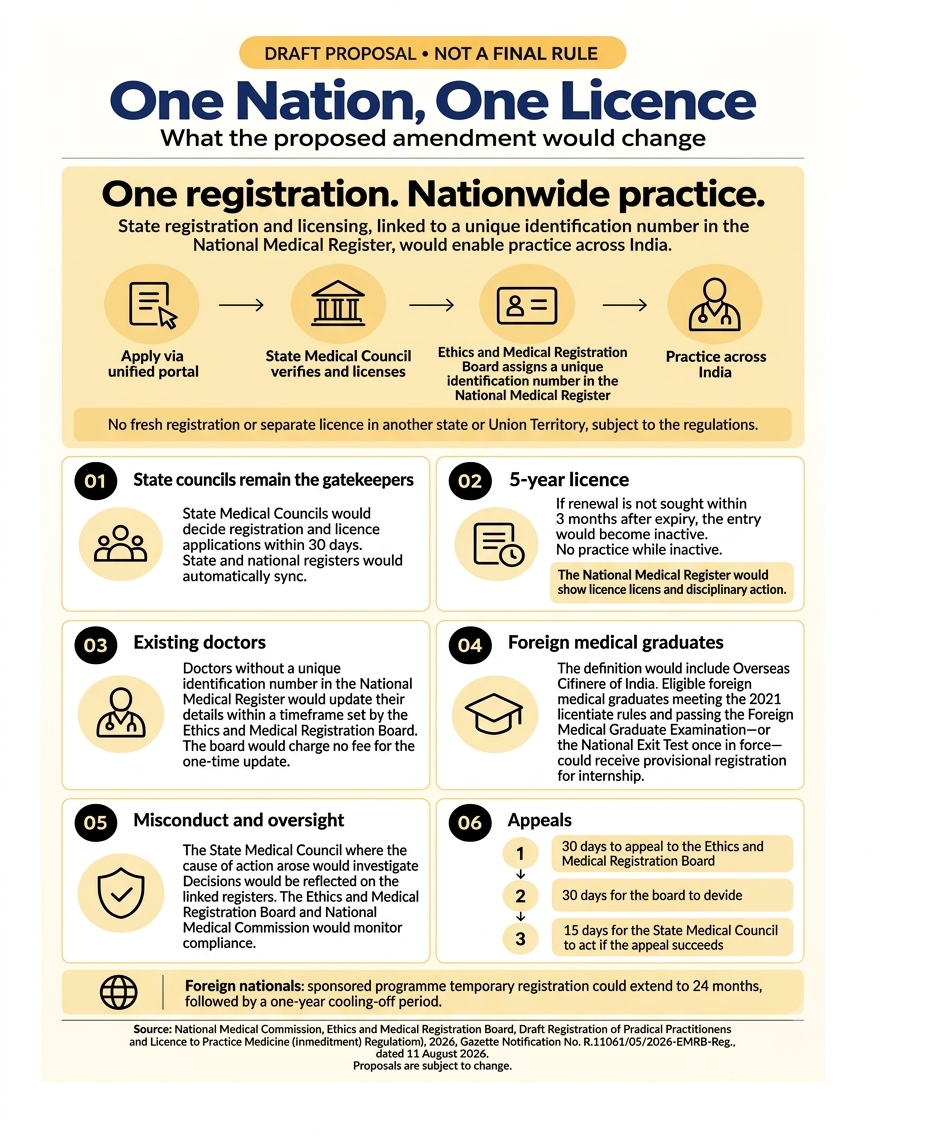
The National Medical Commission has proposed allowing doctors registered with a State Medical Council and allotted a Unique Identification Number in the National Medical Register to practise anywhere in India without securing fresh registration and a licence in every state.
Under the draft regulations, once a State Medical Council grants registration and the Ethics and Medical Registration Board assigns a National Medical Register UID, “the medical practitioner shall be eligible to practise medicine in any State or Union Territory of India without requiring fresh registration and licence”.
If finalised, the framework would create nationwide portability of a doctor’s licence while retaining State Medical Councils’ role in registration, renewal and disciplinary proceedings.
Key provisions in the draft regulations
- The document is the draft Registration of Medical Practitioners and Licence to Practise Medicine (Amendment) Regulations, 2026, issued by the NMC’s Ethics and Medical Registration Board on 11 August 2026.
- These are draft regulations and should not be presented as rules currently in force.
- The regulations would come into force from the date of their publication in the Official Gazette. · The National Medical Register would be maintained by the Ethics and Medical Registration Board.
- Every medical practitioner registered in a State Medical Register would be assigned a Unique Identification Number in the National Medical Register.
- The NMR number would be valid for medical practice across India.
- A doctor must first obtain registration from the concerned State Medical Council.
- After state registration, the EMRB would centrally generate the doctor’s NMR UID.
- After receiving registration and a licence from an SMC and an NMR UID from the EMRB, a doctor would be eligible to practise in any state or Union Territory.
- The doctor would not need fresh registration or another licence to practise in a different state or Union Territory.
- A doctor or eligible foreign medical graduate would apply to the concerned State Medical Council through the EMRB’s Unified Registration Portal.
- The State Medical Council would consider the application for registration and a licence within 30 days after charging the appropriate fee.
- Once approved, the registration would be reflected in both the State Medical Register and the National Medical Register.
- The NMR UID would incorporate the code of the concerned state or Union Territory and the doctor’s State Medical Register number.
- The EMRB would electronically synchronise the national and state registers.
- Any change recorded in one register would automatically be reflected in the other register.
- The NMR would show whether a doctor’s licence was active or inactive.
- It would also contain details of disciplinary action against the doctor.
- The NMR would serve as a central repository for registration particulars, disciplinary proceedings and orders of suspension, removal or restoration.
- The EMRB and NMC could issue directions, seek information, call for records and monitor State Medical Councils’ compliance.
- A licence to practise medicine would be valid for five years.
- The doctor would have to apply to the concerned State Medical Council to renew the licence after five years.
- If no renewal application is received within three months after the licence expires, the doctor’s State Medical Register entry would be marked inactive.
- A doctor with inactive status would not be entitled to practise medicine.
- The inactive status would automatically be reflected in the National Medical Register.
- Existing doctors enrolled in the Indian Medical Register or a State Medical Register but without an NMR UID would have to update their information on the EMRB portal.
- The deadline for this update would be determined by the EMRB. · Existing doctors would receive the NMR UID as a one-time exercise.
- The EMRB and NMC would not charge existing doctors a fee for updating or obtaining the UID.
- Doctors obtaining an additional recognised medical qualification would apply through the Unified Registration Portal to the SMC where they were primarily registered.
- The existing system for registering additional qualifications would continue until the NMR becomes fully operational.
- A complaint of professional misconduct, unethical conduct or medical negligence would be handled by the SMC in whose territorial jurisdiction the cause of action arose.
- That SMC would be authorised to investigate and decide the matter, implement the decision and record it against the doctor’s credentials in the online register.
- If disciplinary action is recommended by an SMC other than the doctor’s primary registration council, the action would be reflected in the NMR.
- The action would also be automatically updated in the State Medical Register maintained by the doctor’s primary registration council. · The primary registration SMC would record the permanent or temporary removal of a doctor’s name from the register.
- The primary registration SMC would also record the restoration of the doctor’s name.
- If an SMC rejects an application for registration, a licence or licence renewal, the applicant could appeal to the EMRB within 30 days. · The appeal would have to include the original application, the rejection communication, written grounds challenging the rejection and the prescribed processing fee.
- The EMRB would examine and decide the appeal within 30 days.
- If the EMRB allows the appeal, its order would bind the State Medical Council.
- The SMC would have to grant the registration, licence or renewal within 15 days of receiving the EMRB’s order.
- The revised definition of a foreign medical graduate would include an Indian citizen or Overseas Citizen of India who obtained a primary medical qualification abroad and does not hold an Indian undergraduate medical degree.
- Eligible foreign medical graduates would have to qualify through FMGE or NExT, once NExT comes into force, and satisfy the Foreign Medical Graduate Licentiate Regulations, 2021.
- Subject to these conditions, an FMG could receive provisional registration for an internship and become eligible for NMR registration.
- A foreign national applying for temporary registration would have to provide a valid good-standing certificate from the competent medical council or licensing authority of the relevant country. ·
- If a postgraduate or super-speciality course is extended, the foreign national would have to apply to the EMRB for extension or renewal of temporary registration.
- Temporary registration for a foreign national could cover the course duration, subject to a maximum of 24 months.
- The temporary registration would be followed by a one-year cooling-off period.
- It would be restricted to the medical college, institution or hospital sponsoring the programme.
- NMC allowed 30 days for objections and suggestions on the draft.
- The notification withdrew an earlier draft issued on 7 April 2026.
Hospital networks see gains from seamless registration
“The move towards a unique national identity and more portable registration for doctors is a very welcome reform. Healthcare delivery today does not stop at state borders, but our licensing architecture often still does. For hospital networks operating across multiple states, removing duplicative registration processes can make it much easier to deploy specialists where they are needed, build locum and visiting consultant models, and expand telemedicine services. This becomes even more important as India rapidly expands its medical workforce. Adding medical seats is important, but access will improve only if we can distribute that workforce more effectively. A national registration framework can help doctors move towards underserved Tier-2 and Tier-3 cities and aspirational districts rather than creating unnecessary administrative barriers to mobility. At the same time, portability should not mean weaker accountability. State Medical Councils have an important role in professional conduct, grievance redressal and disciplinary oversight. The opportunity is therefore not to remove the states from regulation, but to create one interoperable national system in which registration is seamless while accountability remains strong and clearly defined.
Ultimately, we should move towards a simple principle: one doctor, one verified identity, one portable registration—and the ability to serve patients wherever the need exists,” says Shuchin Bajaj, founder of Ujala Cygnus Hospitals.
Single licence could ease recruitment and telemedicine
Sandip Banerjee, founder, Pelvinic Healthcare, is a senior laparoscopic colorectal surgeon, proctologist and bariatric surgeon based in New Delhi.
“The National Medical Commission’s (NMC) proposed Unique ID for a single, portable medical licence could fundamentally reshape India’s fragmented healthcare workforce. This reform arrives amid a seismic expansion: 1,36,939 MBBS seats after 9,911 new approvals, plus a strict bar on colleges with incomplete infrastructure, signalling a push for both quantity and quality.
For hospital administrators, a single licence promises operational ease: simplifying cross-state recruitment and eliminating duplicate state registrations. It will unlock a vibrant locum tenens market, allowing metropolitan specialists to bridge rural shortages. Critically, it provides the legal backbone for telemedicine, enabling a physician in one state to consult a patient in another under a single credential.
State councils may resist erosion of authority
However, the inevitable friction lies with State Medical Councils. Long-standing gatekeepers of regional practice, they face a stark erosion of regulatory power, jurisdictional autonomy and significant fee revenues. While the NMC frames this as patient-centric mobility, state bodies are likely to resist, citing heterogeneous public health statutes and localised ethical nuances that require regional oversight. The “One Doctor” vision’s ultimate success hinges on whether centralised mobility can coexist with state-level accountability. Without a balanced framework, this reform risks creating a regulatory vacuum that prioritises convenience over the nuanced governance of medical ethics across diverse states,” explains Banerjee.
Doctors expect fewer administrative bottlenecks
Dr R. Chinnadurai, Regional Medical Director and Chief of Adult Medical Intensive Care and Emergency Services, KIMS Hospitals, Bengaluru, points out that the
proposal by the National Medical Commission to create one medical licence for doctors in India is indeed a progressive and positive move.
“Currently, many doctors complete their MBBS, postgraduate and super-specialist training in different states through the All-India Quota route and then decide to settle in another state. Under the current system, obtaining a No Objection Certificate (NOC) from one State Medical Council and registering with another can be a time-consuming and cumbersome process, delaying their ability to begin practice. A single national licence would also facilitate doctors’ mobility and help them register under one number across the nation. It would be advantageous for specialised teams, such as transplant teams, which often travel from institution to institution and from state to state. Having opened two hospitals and employed almost 500 doctors ourselves, we know how difficult it is for doctors to obtain an NOC and register in Karnataka. A national licensing regime would not only help remove these administrative bottlenecks but also expedite the deployment of doctors and possibly even strengthen regulation in the process,” concludes Chinnadurai.
Got a story that Healthcare Executive should dig into? Shoot it over to arunima.rajan@hosmac.com—no PR fluff, just solid leads.