
MR-Linac Case Studies
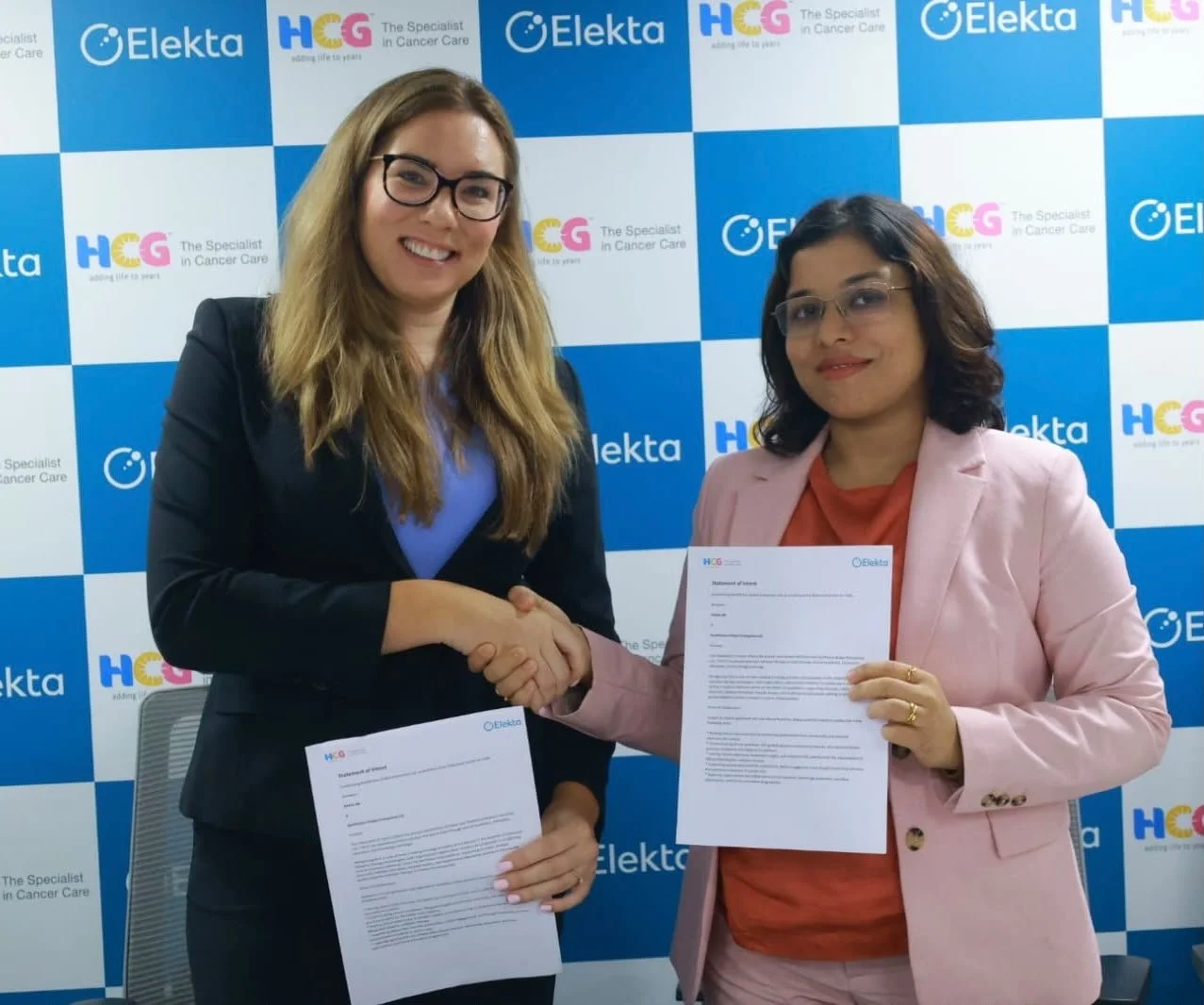
Ms. Manisha Kumar, COO - HCG Karnataka Region and Ms. Linn Boman, Head of Strategy & Government Affairs, TIMEA, Elekta, sign the Declaration of Intent towards educational excellence in Radition Oncolo
Case 1: Oligometastatic lung cancer treated with MR-guided SBRT
(Dr. Lohith G, Consultant Radiation Oncologist, HCG Hospitals)
Background: A 78-year-old man came in with worsening breathlessness. Scans and biopsy found lung cancer (adenocarcinoma) in the left upper lobe that had already spread to one adrenal gland, an "oligometastatic" pattern, meaning the cancer had spread but to only a limited number of sites, which made aggressive, targeted treatment a realistic option.
Route of treatment: Traditional radiotherapy plans off a single scan taken at the start, then treats assuming the tumor stays in place. That's a problem here: the lung tumor sat near the constantly moving chest wall, and the adrenal metastasis sat beside the stomach, bowel, kidney, and pancreas, organs that shift daily. The Elekta Unity MR-Linac took a fresh MRI before every session and adjusts the plan in real time. The patient received 5 sessions for the lung tumor (40 Gy) and 5 for the adrenal metastasis (30 Gy), back-to-back, with no break.
Outcome: All sessions were completed on schedule, treatment was well tolerated, and the patient stayed clinically stable throughout. He was discharged in good condition with a follow-up scheduled two weeks later.
Why it matters for the patient: Treating with tighter margins meant less radiation exposure to healthy tissue nearby, translating to fewer side effects, a short 5-session course instead of weeks of conventional radiation, and no need for invasive surgery, supporting a faster recovery.
Case 2: Persistent lung metastasis after colorectal cancer surgery
(Dr. Lohith G, Consultant Radiation Oncologist, HCG Hospitals)
Background: A 63-year-old woman had colon cancer that had spread to her liver and lung. She underwent chemotherapy, then surgery to remove the colon tumor and liver metastasis. Surgery handled two of the three problem sites, but a metastasis remained in the lower left lung, in a spot that moves considerably with every breath.
Route of treatment: A tumor that shifts with breathing is hard to hit with a fixed plan: clinicians either risk missing it on some breaths or must irradiate a wider "safety margin," exposing more healthy tissue. The MR-Linac solves this with real-time tracking during free breathing, watching the tumor move live on MRI and adjusting the beam accordingly. Her path was chemotherapy, then robotic surgery for the colon and liver disease, then 5 MR-Linac sessions (40 Gy total) with real-time tracking for the persistent lung metastasis.
Outcome: All 5 sessions were completed without interruption, treatment was well tolerated, and she remained clinically stable throughout, discharged in satisfactory condition with a two-week follow-up planned.
Why it matters for the patient: Real-time tracking let the team protect the spinal cord, spleen, and ribs sitting close to the tumor, lowering the risk of long-term side effects in those areas. Because this was a non-invasive, 5-session treatment rather than a second surgery, she was able to complete definitive treatment across all three cancer sites (colon, liver, lung) without further major surgery, supporting a quicker return to normal life.
Case 3: High-risk localized prostate cancer treated with MR-Linac radiotherapy
(Dr. Surendra Reddy T, Consultant Radiation Oncologist, HCG Hospitals Hebbal)
Background: A 74-year-old man came in with increasing urinary frequency. Evaluation led to a diagnosis of high-risk, localized prostate cancer, cancer confined to the prostate but with features that carry a higher risk of recurrence if not treated aggressively.
Route of treatment: His tumor board recommended androgen deprivation therapy (hormone therapy) combined with radical radiotherapy. He was treated on the MR-Linac rather than a conventional linear accelerator, and given hypofractionated radiotherapy, 5 days a week over 5 weeks. Outcome: He completed the full course without interruption and tolerated treatment well, with no reported side effects.
How MR-Linac made the difference: MR-Linac gave the team excellent visualization of the prostate itself, so radiation could be aimed precisely at the tumor rather than a broader estimated zone. That same clarity extended to the surrounding pelvic anatomy, allowing the dose to nearby organs like the bladder and rectum to be minimized rather than treated as unavoidable collateral. Because the system could also correct for prostate movement during each session, not just before it started, treatment stayed accurate throughout every fraction. Together, this meant he could be treated safely, with a real shot at curing the disease, without the side effects typically associated with radiation to this area.
Case 4: Metastatic breast cancer (liver + bone) treated with MR-guided SBRT
(Dr. Surendra Reddy T, Consultant Radiation Oncologist, HCG Hospitals Hebbal)
Background: A 66-year-old woman with stage IV, HER2-positive breast cancer completed chemotherapy combined with immunotherapy. Follow-up PET/CT scans showed the disease had responded well overall, but two isolated spots remained active: one in the liver and one in the left femoral head (hip bone), with no other active disease detected, another case of oligometastatic disease, where only a small, limited number of sites need targeting.
Route of treatment: With only two isolated active sites left, her tumor board recommended stereotactic body radiotherapy (SBRT) rather than continued systemic treatment alone. She was treated on the MR-Linac, which uses daily MRI guidance and online adaptive planning to see soft tissue clearly, precisely locate each target, and better protect organs at risk than conventional imaging allows. She received high-dose SBRT over 5 consecutive treatment days in one week, covering both the liver and hip lesions.
Outcome: Treatment was completed successfully without interruption, and she tolerated it well with no acute treatment-related side effects.
Why it matters for the patient: By precisely targeting two separate, distant sites, liver and bone, in a single short course, MR-guided SBRT let her get definitive, high-dose treatment to residual disease without surgery and without added toxicity, helping consolidate the gains from her chemoimmunotherapy while avoiding a longer, more exposure-heavy course of treatment.
Got a story that Healthcare Executive should dig into? Shoot it over to arunima.rajan@hosmac.com—no PR fluff, just solid leads.