
The One-Year Bridge: Inside Maharashtra's Mixopathy Debate
By Arunima Rajan
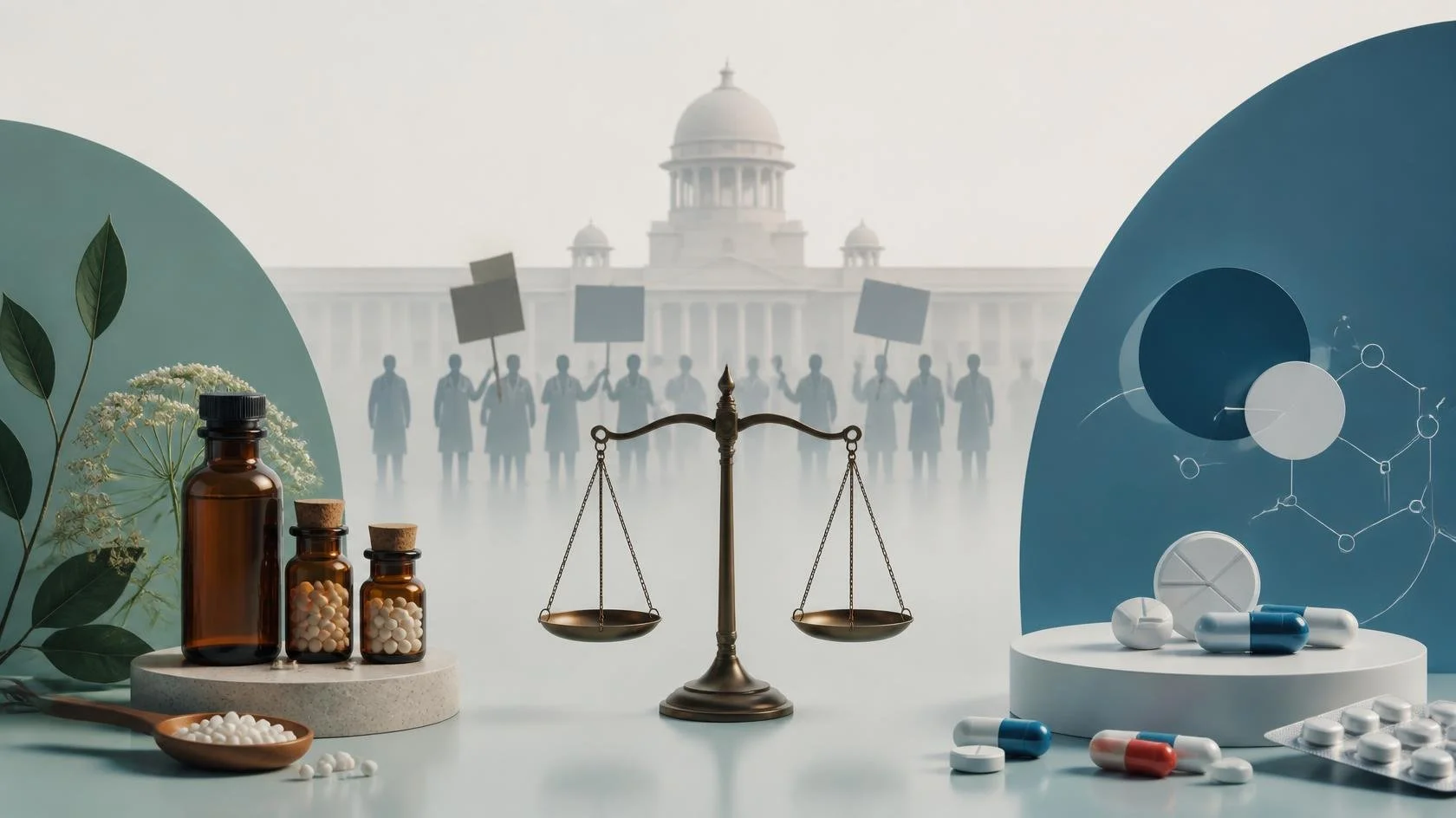
After a brief freeze and reversal, the Maharashtra Medical Council has resumed registering homeopaths under the CCMP scheme, prompting the IMA to demand the Medical Education Minister's resignation and threaten statewide agitation.
Imagine going to the doctor: you are sick, and you see the letters behind their name and trust them completely. But what if those credentials represent a philosophy of medicine entirely different from the one being prescribed to you? That is the crux of a decade-long debate in Maharashtra over whether homeopaths should be allowed to prescribe modern medicine.
It is a major stress test for the medical education sector, with several medical associations opposing the move. At its core, the debate is about what society considers the proper education of a doctor to be.
Where the Debate Began
It all started in 2014, when the state legislature passed an amendment to the Maharashtra Medical Council Act and the Maharashtra Homoeopathic Practitioners' Act. The amendment allowed homeopathic practitioners who completed a bridge course in pharmacology to register with the Maharashtra Medical Council (MMC), though on a separate register. The underlying idea was that the course would create a form of equivalency with MBBS doctors for the purpose of prescribing modern medicine.
The Maharashtra University of Health Sciences (MUHS), Nashik, was tasked with designing the bridge-course curriculum: the Certificate Course in Modern Pharmacology (CCMP).
"I strongly believe that practitioners trained in one system of medicine should not be permitted to practise modern medicine without undergoing the complete education, clinical training and hands-on practice it requires. Healthcare is not simply about learning which medicines to prescribe, it requires years of structured learning, clinical exposure and experience to diagnose conditions and make safe treatment decisions," says Dr Gurmeet Soni Bhalla, Founder, Aryse Health.
"If we allow practitioners from another system of medicine to prescribe modern medicines, we risk overlooking the depth of training and clinical judgement that modern medicine requires. Patient safety has to remain the priority, and expanding the scope of practice cannot come at the cost of adequate medical education, training and accountability."
A Battle Over Medical Boundaries
Dr Sandip Banerjee, a pelvic floor specialist and proctology expert at Pelvinic Healthcare, Delhi, points out that in July 2025 the Maharashtra Medical Council formally allowed homeopathic practitioners to prescribe modern allopathic medicines, provided they completed the one-year CCMP. The first registration under this route was completed in early August 2026, more than a decade after the enabling amendment was passed in 2014, which had remained dormant due to legal challenges and regulatory hurdles.
The government's official rationale, set out in the statement of objects and reasons for the Bill, cited a "continuous demand from different sections of society" and the need to achieve "Health for All." Behind this official reasoning, however, lay a more pragmatic driver: the acute shortage of allopathic doctors in rural areas.
The government's defence of the policy rests on a pressing reality, rural India does indeed suffer from a shortage of allopathic practitioners, and improving access to care in these underserved areas is an urgent public health priority. But does this policy actually solve the problem, or does it merely mask it?
The Indian Medical Association argues that the doctor shortage is, in fact, a myth. India produces over 100,000 medical graduates annually. The real issue, it says, is not production but distribution: a significant number of young doctors are unemployed or underemployed, some earning wages as low as ₹40,000. "The problem is not that there are too few doctors; it is that too few are willing to work in rural areas, and the system has failed to create adequate incentives for them to do so," explains Dr Banerjee.
The Training Gap
Atharv Shinde, president of the Maharashtra Association of Resident Doctors (MARD), says the association is protesting because the certificate course raises serious concerns about patient safety. These courses exist only in Maharashtra, nowhere else in India, and were introduced to address a physician shortage that, in his view, no longer exists. "When the state made this decision, that shortage was real. It no longer is, which makes the policy irrelevant. The state should revoke it," he says.
"If a homeopath prescribes both homeopathic and allopathic medicines and a patient suffers an adverse reaction, who is responsible? How will the medico-legal team handle the case? Medical ethics will be breached in such situations."
Patient Safety at Stake
Dr Montu Tyagi, President, MARD GMC Gondia, and State Convenor, Central MARD, echoes these concerns.
"MBBS doctors are opposing the decision because we believe mixopathy compromises the distinct training and standards of modern medicine," he says. "A short-term CCMP course cannot compensate for the years of structured undergraduate and postgraduate training, clinical exposure and rigorous practice required in modern medicine."
He continues: "When this concept was introduced in 2014, the healthcare workforce situation was different. Today, Maharashtra has a substantially larger number of modern-medicine doctors, and the doctor-to-population ratio has improved considerably. We therefore see no justification for allowing practitioners trained in another system of medicine to enter modern-medicine practice and prescribe modern medicines."
"Our concern is not about homeopathic practitioners practising homeopathy," Dr Tyagi clarifies. "They should be encouraged to practise the system of medicine in which they are formally trained. But allowing them to prescribe modern medicines after only a short additional course effectively creates a parallel route into modern-medicine practice. Years of rigorous MBBS training and clinical exposure cannot be substituted by a one-year course, particularly where patient safety is at stake."
"The biggest concern is patient safety and confusion," he adds. "Giving these practitioners an MMC registration number could mislead patients into assuming they are seeing a fully trained modern-medicine practitioner, when in fact their primary training is in homeopathy."
"Modern medicines, including steroids and other potent drugs, require detailed knowledge of indications, contraindications, drug interactions, adverse effects, dosage and monitoring," he says. "We are concerned that inadequate training in these areas could lead to inappropriate prescribing and potentially serious complications for patients."
Dr Tyagi emphasises: "This is not simply an issue concerning the professional interests of MBBS doctors. It is fundamentally about maintaining clear professional standards and ensuring patients know what system of medicine their doctor is trained and qualified to practise."
He concludes: "We request the Maharashtra government to withhold the proposed registration of CCMP practitioners with the Maharashtra Medical Council, and to reconsider or cancel the CCMP pathway that enables cross-system practice. Every system of medicine should be respected and practised within its own defined scope. If more healthcare personnel are required, the solution should be to strengthen and expand properly trained healthcare professionals, not to create a pathway for practitioners of one system to prescribe and practise another."
The Cost of Implementation Paralysis
Even the Central Council of Homoeopathy, then the national regulator for homeopathy, signalled that it did not favour homeopaths prescribing allopathic drugs, separately directing its own registrants to stick to homeopathic practice. Yet for a homeopath who has already completed the course, the situation remains fraught.
The human cost of this implementation paralysis is hard to ignore. According to newspaper reports, close to 12,500 homeopaths have completed the CCMP course, but as of the latest report, only three have actually been enrolled with the Maharashtra Medical Council. It is, by any measure, a staggering story of systemic failure.
Got a story that Healthcare Executive should dig into? Shoot it over to arunima.rajan@hosmac.com—no PR fluff, just solid leads.