
Hospitals can find diabetes. Can they keep patients in care?

Screening is the easy part. What happens to patients after the test comes back positive? Healthcare Executive asked clinicians at The Women’s Hospital, Wockhardt Hospitals, Mira Road, and Aster Whitefield; an insurer, ManipalCigna; and a healthcare manager in Sharjah.
We asked five experts: once a hospital finds diabetes, how many patients does it keep? Only one put a number on it.
“In our tertiary care practice, approximately 75% of patients return for follow-ups,” says Dr Punya Chopra, Senior Consultant, Internal Medicine, Diabetologist & Rheumatologist at The Women’s Hospital. Then she adds what usually goes unsaid. “However, this is an estimate based on my clinical experience, as we do not have formally audited retention data.”
That honest answer is the heart of this story: none of the five offered an audited figure for patient retention.
After the test
“India has 89.8 million adults living with diabetes, and for many of them, a positive screening result is only the first step,” says Dr Rakhi Gyanchandani, Head, Underwriting and Wellness at ManipalCigna Health Insurance.
The national numbers show how many are lost after that first step. A 2019 study in BMC Medicine, drawing on a 2015-16 household survey of Indians aged 15 to 49, found that of all those with diabetes, 52.5% were aware of their condition and 24.8% had it under control. The ICMR-INDIAB study, published in The Lancet Diabetes & Endocrinology in 2022, looked only at adults who reported having diabetes and found good glycaemic control in 36.3% of them. The two studies measured control differently, so the figures cannot be compared directly.
Where patients go missing
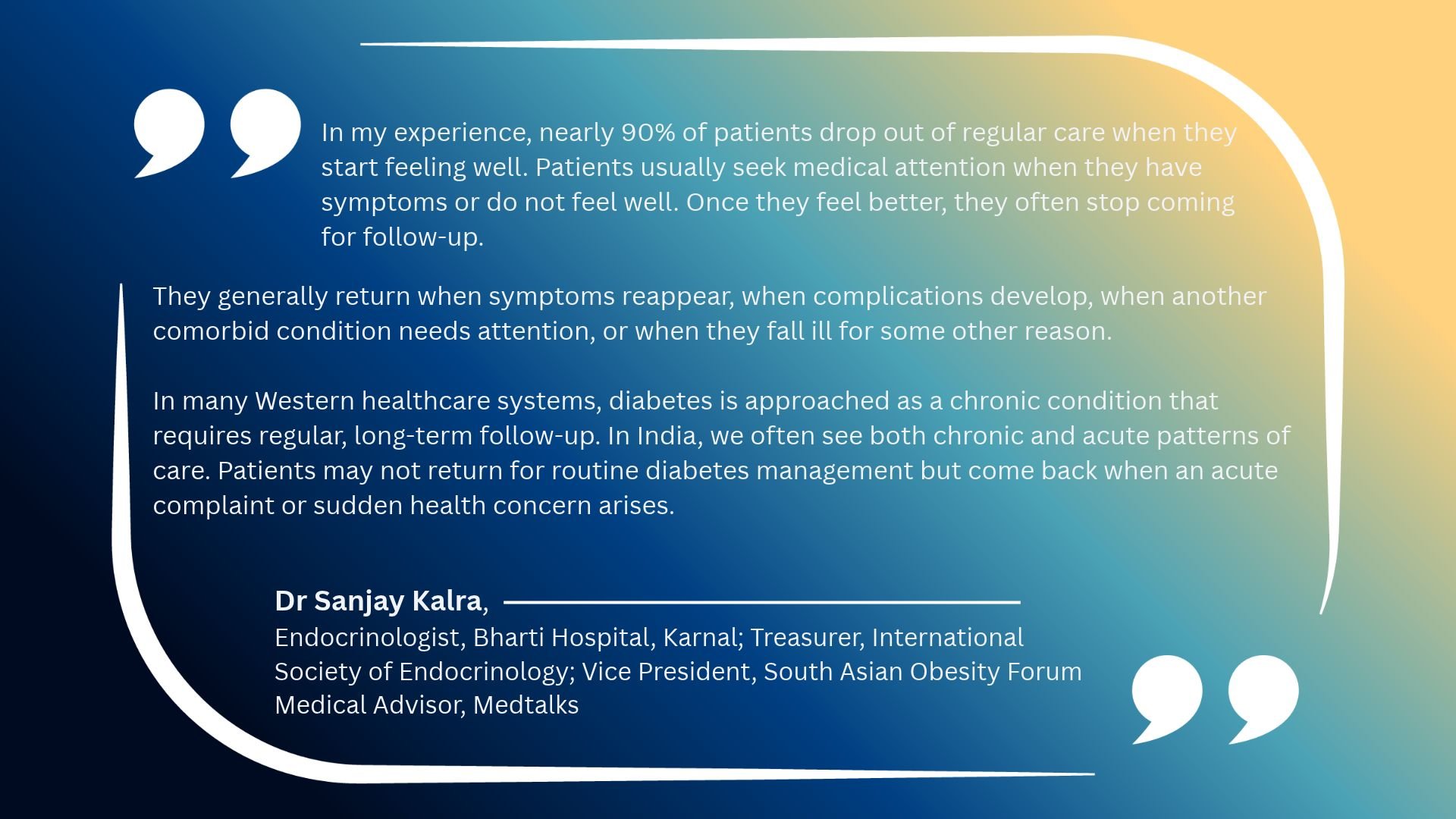
Patients do not go missing at the start. “In my experience, attrition occurs less often at initial confirmation and more often during long-term monitoring, lifestyle modification and treatment intensification,” says Chopra. “Patients may seek multiple opinions, discontinue follow-up once glucose improves, or underestimate the progressive nature of diabetes.”
Read the middle of that list again. Patients stop coming when their numbers get better.
Dr Vasim Shaikh, Consultant General & Laparoscopic Surgeon at Wockhardt Hospitals, Mira Road, sees a second break in the chain. “The biggest challenge is fragmented care,” he says. “Patients may consult a diabetologist but overlook foot examinations or delay referrals to surgeons.”
The chain breaks at the eye too. “A patient may undergo screening, but if the findings aren’t communicated, referrals are delayed or follow-up is missed, an opportunity to prevent avoidable vision loss can be lost,” says Dr Samer Al-Diri, Medical Centre Manager and Director of Healthcare Services at Sharjah Consultancy Centre for Modern Medical Care.
It is tempting to treat all this as a scheduling problem, but the research points beyond the appointment diary. A 2020 systematic review of 34 studies, published in Diabetic Medicine, found that younger adults, smokers and people under financial pressure were less likely to attend diabetes outpatient appointments, and that non-attendance was associated with higher HbA1c.
Al-Diri learnt this on a 2025 assignment in Nauru, in the South Pacific, where he worked on diabetic retinopathy care. One patient needed retinal laser treatment and injections for severe diabetic eye disease. “We spoke to him repeatedly, and he confirmed that he would attend, yet he missed three appointments,” he says.
A district nurse visited the man at home. “In person, he explained that he lived remotely and had no transport,” says Al-Diri. “He worried that requesting transport would be disrespectful to the clinicians or burden the service, something he had not been willing to say on the phone.” The nurse arranged transport. The patient attended treatment and follow-up, and his vision improved.
“That experience changed how I think about non-attendance,” says Al-Diri. “We had kept asking whether he would come, when we should have asked what was stopping him.”
What it costs
Shaikh meets these patients late. “We increasingly see patients seeking specialised care only after developing non-healing ulcers, infections, tissue damage or loss of sensation,” he says.
He notes that “up to 25% of people with diabetes may develop a foot ulcer during their lifetime”. “In diabetic foot management, even a small delay in treating an infection can have serious consequences, including amputation,” he says.
What works
Chopra’s list is not glamorous. “Continuity of care depends on structured follow-up systems, nurse-led counselling, inputs from pharmacists and dietitians, digital reminders and proactive follow-ups with patients who miss appointments,” she says.
There is trial evidence for this kind of support. A randomised trial of 1,146 patients with poorly controlled type 2 diabetes at clinics in India and Pakistan, published in Annals of Internal Medicine in 2016, added non-physician care coordinators and decision-support electronic health records to usual care. The share of patients who reached their treatment targets was more than double: 18.2%, against 8.1% with usual care.
Wockhardt answered fragmentation by putting the specialists in one place: a dedicated diabetic foot clinic. “By reducing fragmented consultations and ensuring timely specialist referrals, we aim to preserve limbs, prevent avoidable amputations and improve patients’ quality of life,” says Shaikh.
Putting specialists in one place does not settle whether the patient arrives. Al-Diri’s management fixes include “clearer referral responsibilities, better communication between clinical teams, reliable patient recall systems and monitoring whether referrals actually result in completed appointments”. The last item on that list is a number a hospital can track.
For a resource-stretched Indian district hospital, he would begin with “a trusted local nurse or care coordinator, a basic referral register and a process for following up missed visits”.
So who pays?
Start with what patients spend. A 2023 study in the Indian Journal of Medical Research surveyed 165 outpatients with diabetes at PGIMER, Chandigarh, in 2018-19. It put their mean out-of-pocket spending at ₹4,381 per visit, including medicines, tests and travel, and found that 20% of them incurred catastrophic health expenditure.
Insurance was not built for this kind of care, and Gyanchandani says as much. “While health insurance has traditionally centred on hospitalisation, managing chronic conditions such as diabetes requires a more sustained and proactive approach to healthcare.”
Researchers ask for more. A 2025 study from Punjab in the same journal recommended that the state’s government health insurance scheme cover outpatient and diagnostic costs for diabetes.
Then there is the work nurses, diabetes educators and care coordinators do between visits. “Such services could be provided via hospital-sponsored care programmes, bundled packages, or paid consultations,” says Dr Narendra BS, Lead Consultant, Endocrinology & Diabetology at Aster Whitefield Hospital.
Chopra splits the bill. “Healthcare providers should invest in basic recall and follow-up systems, while insurers and public health programmes should support structured diabetes education and multidisciplinary care,” she says.
Start by counting
Go back to that 75%. A senior diabetologist at a tertiary hospital is working from an estimate, and she is the only one who told us so. Is your hospital doing the same?
“Continuity of care is a shared responsibility between hospitals, healthcare professionals and patients,” says Shaikh.
Shared responsibility is a fine principle. It works better when someone keeps count.
Got a story that Healthcare Executive should dig into? Shoot it over to arunima.rajan@hosmac.com—no PR fluff, just solid leads.