
Gleneagles Hospital Restores Hand Function in Engineer Through Advanced PIP Joint Replacement
For the first time in Western India, the Hand Surgery team at Gleneagles Hospital, Parel, Mumbai, performed a PIP joint replacement using the KLS Martin CAP-FLEX joint replacement system, giving a severely injured 40-year-old electrical engineer a chance to regain the hand function he needed for his livelihood.
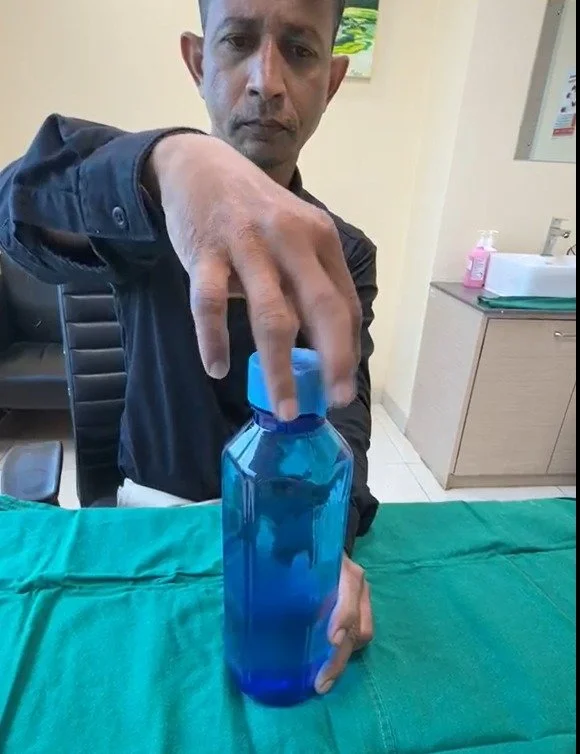
The complex reconstructive procedure was aimed not merely at correcting the damaged finger, but at restoring useful movement, stability and overall hand function. At his three-month follow-up, the patient had regained encouraging finger movement and, most importantly, was able to resume his professional activities.
For Sandeep Sonawane who resides in Kalyan and works as an electrical engineer his hands are an essential part of his professional life; his tools, his livelihood, and his independence. However, a serious injury to his right hand suddenly changed everything.
Multiple fractures had severely damaged his middle finger on his right hand, leaving the proximal interphalangeal (PIP) joint healed in a malunited and poorly functional position. Despite undergoing treatment and therapy locally for nearly three months, his hand remained severely stiff, with persistent pain and restricted movement. Even routine hand movements had become difficult.
As his recovery failed to progress despite therapy, his treating orthopaedic surgeon recognised that the injury required specialised intervention and felt that an expert hand surgeon was needed to assess the extent of the damage and determine whether meaningful hand function could be restored. Sandeep was subsequently referred to Dr. Kushal Shah, Hand Reconstructive and Brachial Plexus Surgeon and Head of the AURA Hand Surgery Unit at Gleneagles Hospital, Parel.
For Sandeep, this was not simply about repairing an injured finger. His ability to work and remain independent depended on getting his hand functioning again. What he needed was not merely another treatment, but a chance to get his working hand back.
Dr. Kushal Shah, said, “For this patient, the injury was affecting much more than a single finger. His iddle finger had sustained significant trauma, and the PIP joint had healed in an abnormal position, leaving him with pain, stiffness and poor function. As an electrical engineer, he relies on his hands for his professional activities, so restoring hand function was closely linked to restoring his independence and livelihood.
“By the time he came to us, he had already undergone treatment and therapy for around three months, but his hand remained severely stiff and functionally compromised. We carefully assessed the extent of joint damage, the condition of the bone, joint stability, tendon function and his functional requirements before considering PIP joint replacement using KLS Martin CAP-FLEX system as a reconstructive option.
“Our objective was not simply to correct the deformity, but to create a stable and functional finger that could once again contribute to the overall movement and usefulness of his hand.”
Dr. Shah further added, “The PIP joint is extremely important for everyday hand function because it helps us bend the finger, make a fist, grip objects, and perform precise movements. In a severely damaged joint, treatment can be technically challenging, particularly when the patient is relatively young and needs his hand for work.
He emphasised that joint replacement is not a solution for every damaged finger, saying, “Every complex hand injury is different, and treatment has to be individualised. Factors such as the patient's age, occupation, extent of joint destruction, bone stock, tendon function, stability and expectations all have to be considered before deciding on reconstruction.
PIP joint replacement is a technically demanding procedure and should be offered only to carefully selected patients. However, with advances in implants and reconstructive techniques, it gives hand surgeons another option when conventional procedures may not provide the functional outcome required. For working individuals, particularly those whose livelihood depends on their hands, the ultimate goal is not simply to repair an injured joint; it is to help them regain the ability to perform meaningful activities in their daily and professional lives.
Following surgery, the patient was discharged and continued “Three months after surgery, his recovery has been measured not only through clinical assessments, but through a much simpler and more powerful question: Can he use his hand again? The answer has been encouraging.”
The patient; Sandeep said, “After the injury, I never imagined that using my hand normally for work would become such a difficult task. Even after undergoing treatment and therapy for several months, I was still struggling with a stiff and poorly functioning hand. I was worried about whether I would be able to return to my work and use my hand the way I once did.
Being referred to Dr. Kushal Shah and eventually being able to move my finger again has given me back something I had begun to worry I might lose; my confidence and independence. Being able to return to work means a great deal to me. I am deeply grateful to the doctors and the entire team for helping me get back to doing what I love.”
“Hand reconstruction is ultimately about giving patients back the ability to use their hands for the things that matter to them. In this case, the patient's hand was directly connected to his profession and livelihood, so restoring function had a much deeper meaning than improving movement alone. The first such PIP joint replacement in Western India at our centre highlights the growing possibilities in complex hand reconstruction. For this engineer, regaining useful finger movement and moving back towards his professional life is the outcome that matters most,” concluded Dr. Bipin Chevale, CEO, Gleneagles Hospital Mumbai.
Got a story that Healthcare Executive should dig into? Shoot it over to arunima.rajan@hosmac.com—no PR fluff, just solid leads.