
India’s Healthcare & Pharma sector to witness a 30–35% hiring uptick by 2030: Adecco India
Digital health and AI set to reshape nearly 30–35% of the workforce

India’s healthcare and pharmaceutical sector is entering a more capability-led phase of growth, with hiring increasingly aligned to specialization, regulatory depth, and technology integration rather than volume expansion alone. This is reflected across a broad healthcare ecosystem spanning hospitals (allopathy and AYUSH), home and elder care, pharmaceuticals and life sciences, diagnostics, telemedicine, clinical research, and public health systems. As demand continues to grow, the sector is expected to create over 2 – 2.5 million new jobs by 2030, with nearly 30–35% of the workforce likely to undergo reskilling, reflecting a shift in how roles are defined across care delivery, research, and manufacturing.
This growth is closely linked to the sector’s expanding economic footprint. Healthcare spending, which stood at 3.3% of GDP in 2022, is projected to near 5% by 2030. This is supported by clinical research activity, digital health adoption, and continued global outsourcing of pharmaceutical development and manufacturing. Diagnostics, preventive healthcare, and telemedicine are also expected to drive an estimated 20-25% increase in demand for distributed and remote care roles, particularly across Tier II and III markets. Hiring for advanced R&D and regulatory roles is expected to increase by 25-30%, aligned with a shift towards complex generics, specialty therapies, and biologics.
India’s positioning within global pharmaceutical value chains is also strengthening, with expansion of the CDMO and CRDMO ecosystem driving an 22-25% increase in hiring across formulation development, process engineering, QA/QC, regulatory, and supply chain functions. This is further supported by 15-20% growth in GCCs, now accounting for 55+ centres with over 300,000 professionals supporting clinical data, pharmacovigilance, and regulatory workflows. Additionally, the medical devices and MedTech segment is also seeing 20% uptick in hiring across manufacturing, quality, and compliance roles.
“Hiring demand today is strongest at the intersection of clinical care scale-up, biologics-led pharma innovation, and digital health transformation, with a clear shift towards specialized, tech-enabled, and compliance-driven roles rather than traditional volume hiring. Employers are also facing a dual challenge of volume shortages in core healthcare roles and capability gaps in specialized talent, making skill development, retention, and geographic distribution a critical workforce priority. While 65-70% of hiring remains concentrated across Bengaluru, Hyderabad, Mumbai, Chennai, and Delhi-NCR, there is a gradual increase in hiring activity across Tier II and III locations such as Pune,Ahmedabad & Coimbatore, supported by expansion in hospital networks, manufacturing clusters, and distributed delivery models. Global uncertainties, including supply chain disruptions and softer international patient inflows, are also emerging as near-term variables, leading to more cautious workforce planning despite a strong long-term hiring outlook”, said Peush Saproo, Associate Director and Head of Sales – Permanent Recruitment, Adecco India.
Entry-level demand accounts for 55-60% of hiring across nurses, lab technicians, paramedics, manufacturing associates, and field sales roles, particularly in Tier II and III markets, with the demand growing an estimated CAGR of 12-25%. Mid-level roles contribute 30-35% of demand, driven by clinical research, QA/QC, regulatory, and hospital administration, while senior-level hiring represents 10-12%, concentrated across R&D, medical affairs, regulatory, and digital health, where capability gaps are most pronounced. Beyond this, the care economy is also expanding, with rising demand for allied health professionals and caregivers growing 15-20% Y-O-Y. Alongside mid-skill, tech-enabled roles such as medical coding, health data, and telemedicine support are also growing by 20-25%. This is reflected in compensation trends, with professionals with 3–5 years of experience in clinical and hospital roles typically earning 4-7LPA, compared to 7-10 LPA in biotech, clinical research, and health data analytics, while roles in regulatory, digital health, and global clinical operations command premiums of 20-30%. Similarly, at the mid and senior level compensations are growing at a media average of 10-15% Y-O-Y.
“Over the next 5-7 years, hiring in healthcare and pharma will be shaped by India’s emergence as a global talent supplier, with an estimated 25-30% increase in overseas demand for healthcare professionals across key markets such as the Middle East, Southeast Asia, the UK, and other developed regions, creating additional employment pathways for Indian doctors, nurses, and allied health workers. This is also reflected in the changing mix of roles, with 30-40% of demand concentrated in clinical data, pharmacovigilance, and regulatory functions, particularly within CROs and CDMOs. As this shift accelerates, demand for hybrid, tech-enabled roles combining clinical and digital capabilities will continue to rise, prompting organisations to adopt more strategic workforce planning with a stronger focus on capability building, retention, and accessing talent beyond traditional metro hubs,” Peush added.
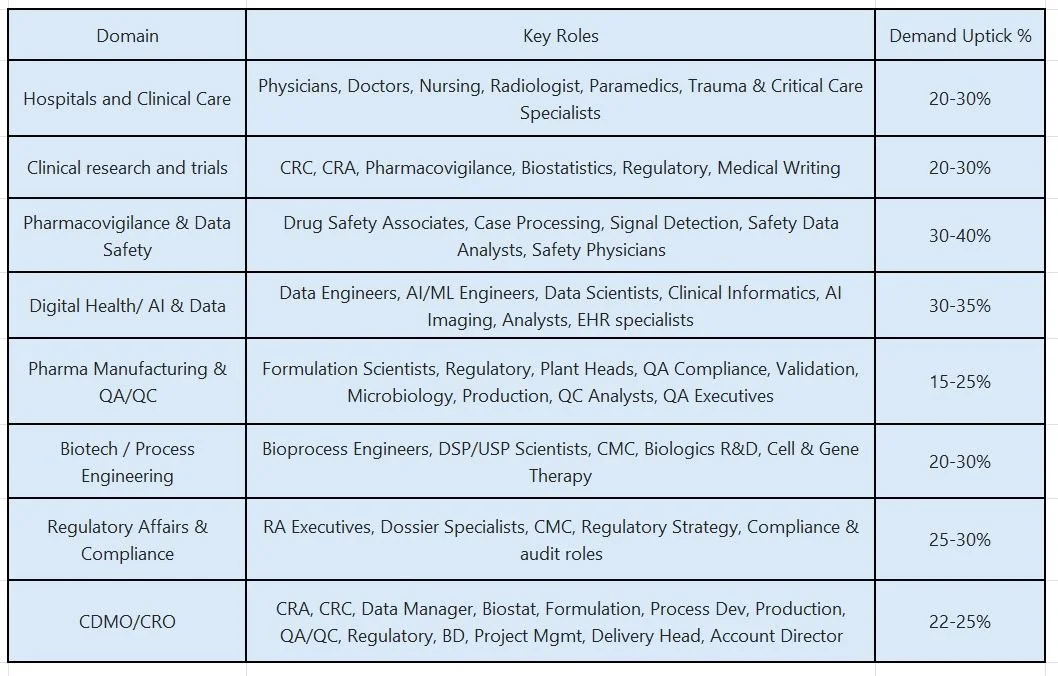
India is strengthening its position as a dual engine for healthcare delivery and biopharma innovation. Sustained investment in infrastructure, policy support, and capability building is expected to drive both large-scale workforce expansion and deeper specialization, with the future workforce defined by clinical expertise, regulatory alignment, and digital fluency. This commentary is created by studying insights from the 100+ client base of Adecco India.
Got a story that Healthcare Executive should dig into? Shoot it over to arunima.rajan@hosmac.com—no PR fluff, just solid leads.