
Rolling out a smoother path for slowing steps
By Arunima Rajan

How hospitals can make it easier for their 70-plus patients to use their services
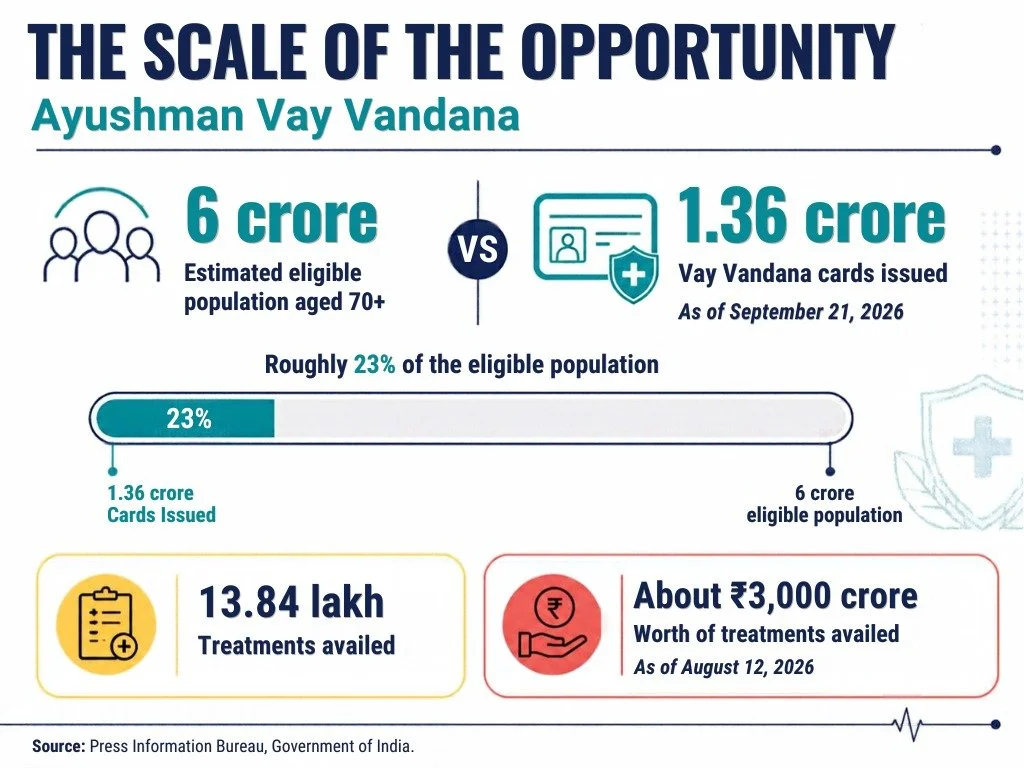
More older Indians are walking into hospitals ever since Ayushman Vay Vandana (AVV) was launched in October 2024. AVV is a health insurance scheme launched by the Government of India to provide free medical coverage for senior citizens aged 70 and above. By early 2026, over 10.33 lakh hospital admissions amounting to ₹2,154.37 crore were authorized for Vay Vandana cardholders, according to the Press Information Bureau. While the AVV scheme has improved access to treatment, senior citizens have to grapple with many other factors in this endeavour. Right from booking an appointment and approaching a hospital to collecting reports and making payments can be a struggle in today’s technology-dominant world.
“We have seen an increase in the number of senior citizens seeking hospital care, including patients aged 70 and above,” says Renjith Krishnan, Managing Director and CEO of Kinder Hospitals. “At the hospital level, the response has to go beyond simply increasing bed capacity. Older patients often need more time, clearer communication and help navigating the hospital.”
It’s not just dealing with apps and appointments, hospital corridors are long. “Our focus is on reducing waiting and confusion, improving accessibility and strengthening support at registration, diagnostics, admission and discharge,” Krishnan says.
Restoring the human touch
At Apollo Hospitals in Bengaluru’s Bannerghatta Road, the answer has been to put people back into the process. Dr Steve Paul Manjaly, geriatrician, says the hospital has installed a dedicated concierge team for its Seniors First programme. Staff help with billing and, when needed, walk patients to the right department. For admitted patients, billing is often done at the bedside.
Outpatients enrolled in Seniors First are assigned a health manager they can reach on WhatsApp or by phone to book appointments, arrange home care or make payments without going through the usual queues. Reports are sent by WhatsApp or email to those who find using apps difficult. When a patient cannot use a smartphone at all, the team shares details with their children or family and speaks to the patient by phone.
Ensuring a seamless experience
Older patients rarely see just one doctor. Apollo has a dedicated team of geriatricians, a geriatric social worker, geriatric assistants and a physiotherapist, Dr Manjaly says. The concierge team coordinates between specialists.
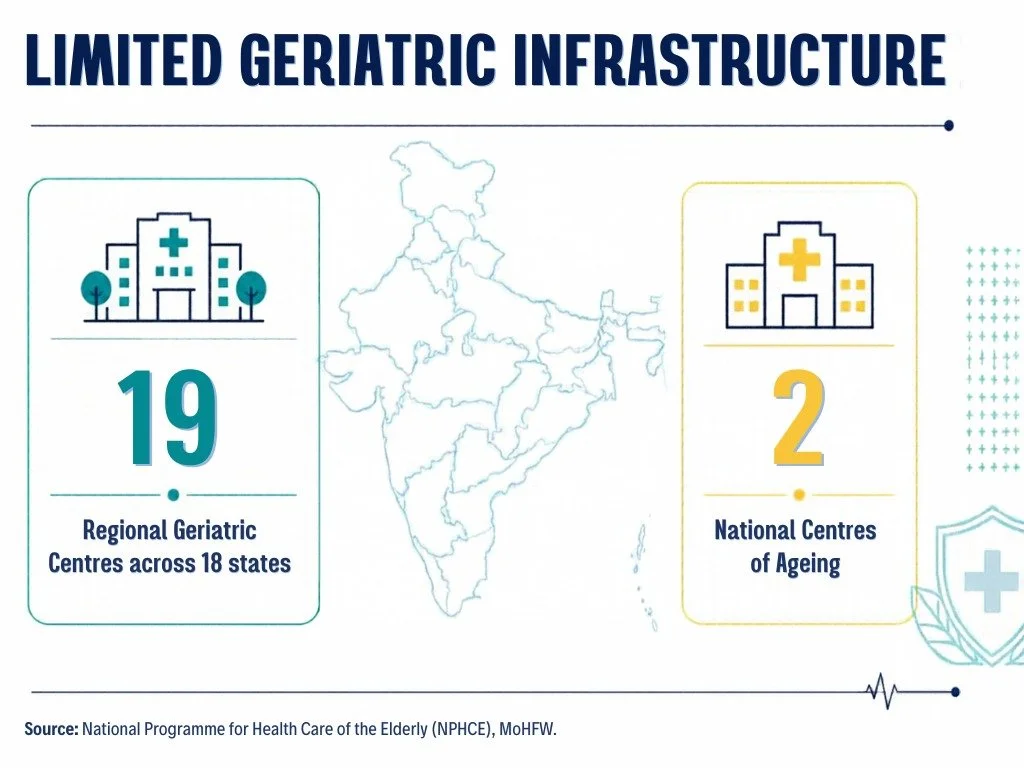
Most hospitals do not have that depth. India still has too few trained geriatric professionals, a gap that the government’s National Programme for Health Care of the Elderly acknowledges, says Krishnan. He argues that the specialist cannot be the whole answer. “Geriatric care, however, cannot depend only on the availability of a specialist. It needs a multidisciplinary approach.” General physicians, emergency doctors, nurses, pharmacists, physiotherapists and dietitians all need to recognise falls, frailty, polypharmacy, delirium and functional decline, he says. “Where a dedicated geriatrician is not available, this multidisciplinary model helps ensure that the older person’s age-related needs are not overlooked during treatment for the primary medical condition.”
Assessing the confusion
One of the hardest moments is when an older patient arrives confused. Krishnan warns against assumptions. “Cognitive impairment should not automatically be equated with an inability to make medical decisions,” he says. “Older patients arriving with confusion may have delirium, dementia, medication-related problems, infection, metabolic disturbances or other reversible causes.”
Where dementia is already diagnosed, Dr Manjaly says, the geriatric team starts by talking to the family, estimating how well they understand the condition and explaining it where needed. The family then becomes the decision-maker for further treatment, including surgery, with decisions weighed against how independent the patient was before. Sometimes a family meeting is held to set out benefits and risks.
“Always, shared decision-making is the one important thing we consider the most when it is about any treatment we offer, whether it is a patient with dementia or not,” he says. “The only difference is that family becomes the decision-maker if the patients themselves are unable to decide due to dementia or any other condition.”
The team also asks families what the patient said while they were still well. “For example, some patients may have expressed wishes like ‘Do not put any tubes into me’, which plays an important role in the treatment plan.”
Managing lone patients
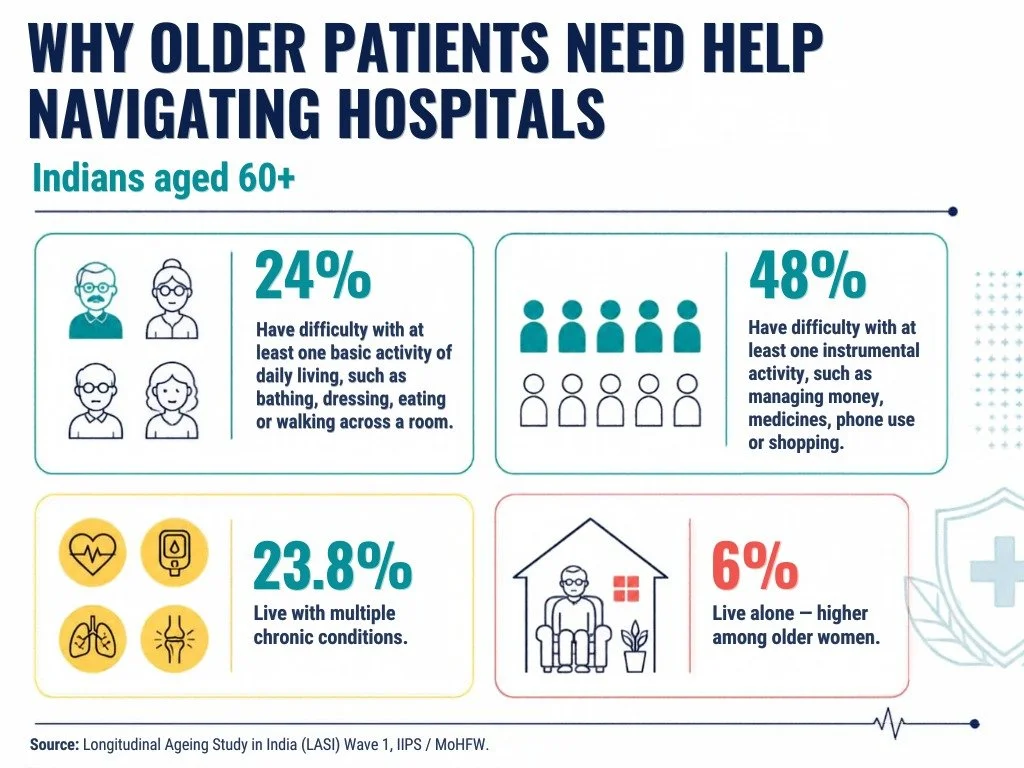
Some older patients arrive alone. “The first principle is that the absence of a family member should not delay necessary emergency medical care,” Kinder’s Krishnan says. In an emergency, assessment and stabilisation come before paperwork. For non-emergency care, the patient’s capacity and wishes have to be assessed, and if capacity is lacking, legal and institutional procedures to identify a decision-maker apply.
Resolving billing woes
Confusion surfaces again at the insurance desk. “Most often the older adult will present to the Emergency with complaints of difficulty walking, or in a confused state, or with excessive tiredness,” Dr Manjaly of Apollo says. “These are atypical presentations of serious illnesses which are very common in older adults, but do not fit into the recognised terminology for insurance companies. Hence insurance gets rejected in many cases, which we address by providing the insurance company an explanation letter about the necessity and urgency of the current admission,” he adds. “This may get resolved in some cases or may not even get resolved which causes a major problem for the family and the patient.”
Recovery is the second gap. “The other problem is most insurance companies do not support post-acute illness rehabilitation, which is vital for a complete recovery.” Without that support, families opt for early discharge, and recovery takes far longer.
The third is the caregiver. Often it is an elderly spouse, and “if the bystander is the spouse, they mostly have difficulty understanding the bill or even waiting in the billing department or coping with the insurance processes,” Dr Manjaly says. Apollo offers bedside billing and help with insurance through its concierge team.
Discharge, with care
Discharge is where the support often ends. “An older person who lives alone or arrives without family support may require additional assessment before discharge, about whether they can manage medications, mobility, nutrition and follow-up independently,” Krishnan says. He advocates for clear instructions on medicines, warning signs and follow-up, in readable print and in a language with
which the patient is comfortable. High-risk patients should be prioritised for early contact after discharge.
“The objective is not to make family presence a condition for treatment, but to ensure that an older patient is discharged into a safe and workable care arrangement,” he says. “The larger goal is continuity of care, ensuring that the older patient does not move from a highly supported hospital environment to an unsupported home environment without a plan.”
Double-click to edit...
Got a story that Healthcare Executive should dig into? Shoot it over to arunima.rajan@hosmac.com—no PR fluff, just solid leads.